Sweet • Sour • Savory

Food blog on scandinavian style food done right.

Bread

Pigs in a Blanket - Pølsehorn

Bread, Brunch, Dinner, Meats, PorkTove Balle-PedersenComment
Pigs in a Blanket - Pølsehorn

Pigs in a Blanket - Pølsehorn

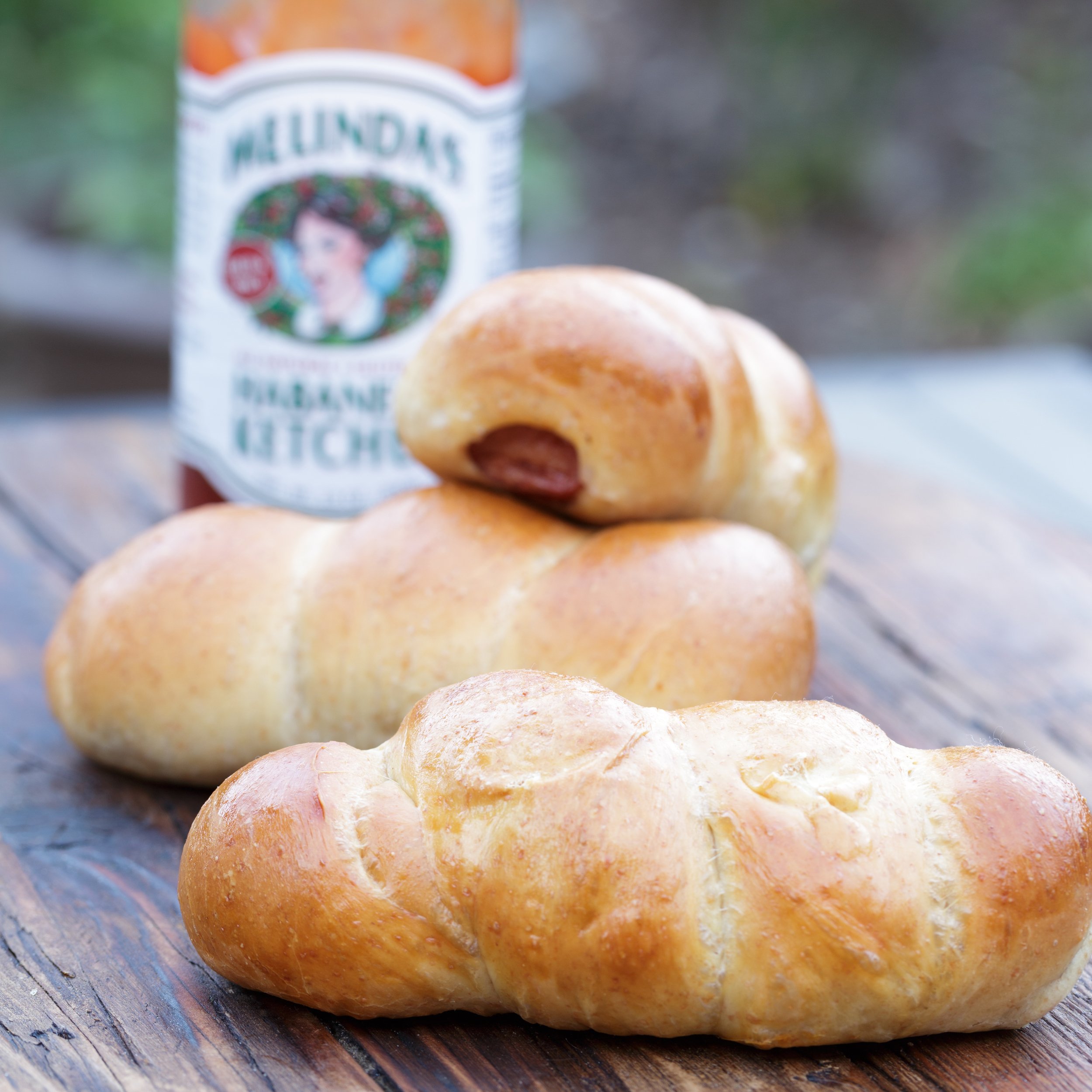
Pigs in a blanket aka pølsehorn is a favorite among kids and adults all over the world.  They are perfect for kids birthday parties or as an easy snack or lunch. You cant eat them cold, warm or hot with your choice of condiments. 

Ingredients:

10 German style Wieners 

Dough:

  • 50 g live yeast (or 4 teaspoons dry yeast)
  • 250 g water
  • 1 teaspoon salt
  • 2 tablespoons sugar
  • 3 tablespoons milk
  • 40 g butter (salted)
  • 1 egg
  • 425 g all-purpose flour
  • 100 g spelt flour
  • 1 egg for egg-wash 

Directions:

In a bowl combine warm water, milk, yeast and sugar. If you use dry yeast let the mixture stand until foamy, about 5 minutes. 

In the stand mixer bowl, whisk flours with salt. Add butter and mix it with a flat beater until the flour looks like crumbs. (Well the dough hook works too.) Stir in yeast mixture and egg until a dough forms. Knead the dough for 5-8 minutes on medium, (8-10 minutes if kneaded by hand), until smooth and elastic. 

Let the dough rise covered for 1 - 2 hours until doubled in bulk.

Cut the wieners in half. Line a baking sheet with parchment paper.

Pour the dough onto a lightly floured workspace, fold the dough over 3-4 times and using dough scraper, divide the dough into 18-20 small balls. Gently roll each ball into a 11-inch/30 cm  rope, and wrap the dough around the half wiener. Squeeze the ends onto the rest of the dough, so it won't unroll when rising.

Cover the pigs loosely with a clean kitchen towel and let to rise in a warm place for one hour.

Preheat oven to 400℉/200℃ with rack in center. Beat an egg and brush some on top of pigs. Bake until tops are golden brown, about 15 minutes.

Transfer to a rack to cool before serving.

Serve the pigs in a blanket with your favorite condiment. 

Enjoy!

This post has been submitted to YeastSpotting

The Danish version:

Ingredienser:

  • 50 g gær (eller 4 tsk tørgær)
  • 250 g vand, lunkent
  • 1 tsk salt
  • 2 spsk sukker 
  • 3 spsk mælk
  • 40 g saltet smør
  • 1 æg
  • 425 g hvedemel
  • 100 g speltmel
  • 1 æg, til pensling

Fremgangsmåde:

Bland det lunkne vand med mælk, gær og sukker. Hvis du bruger tørgær, så lad blandingen stå indtil det begynder at skumme.

I en røremaskine bland melene, salt og smør, indtil smørret er blandet ordentligt med melet, så det ligner krummer. Kom gærblandingen og ægget i. Rør indtil det er blevet til en dej. Ælt dejen i 5-8 minutter. (Ælt 8-10 minutter, hvis du gør det i hånden). Du skal ende op med en jævn og elastisk dej.

Lad dejen hæve tildækket i skålen i 1-2 timer, eller til den er doblet i størrelse.

Halvér pølserne., og kom bagepapir på et par bageplader.

Hæld dejen ud på et bord drysset med mel. Fold dejen 3-4 gange og del dejlen i 18-20 lige store stykker/boller. Rul bollerne ud til ca. 30 cm lange pølser, og sno dejen rundt om pølserne. Pres enderne ind i dejen, så snoningen ikke ruller op, når pølsehornene hæver.

Dæk pølsehornene med et rent viskestykke, og lad dem hæve i omkring 1 time.

Opvarm ovnen til 200℃. Pensel pølsehornene med det sammenpiskede æg, og bag dem i ca 15 minutter indtil de er gyldne og gennembagte.

Køl pølsehornene lidt af inden de serveres.

Server pølsehorn med sennep og ketchup.

Velbekomme!
 

Hveder - Hvedeknopper

Bread, HolidayTove Balle-Pedersen1 Comment
Hveder - Hvedeknopper

Hveder - Hvedeknopper

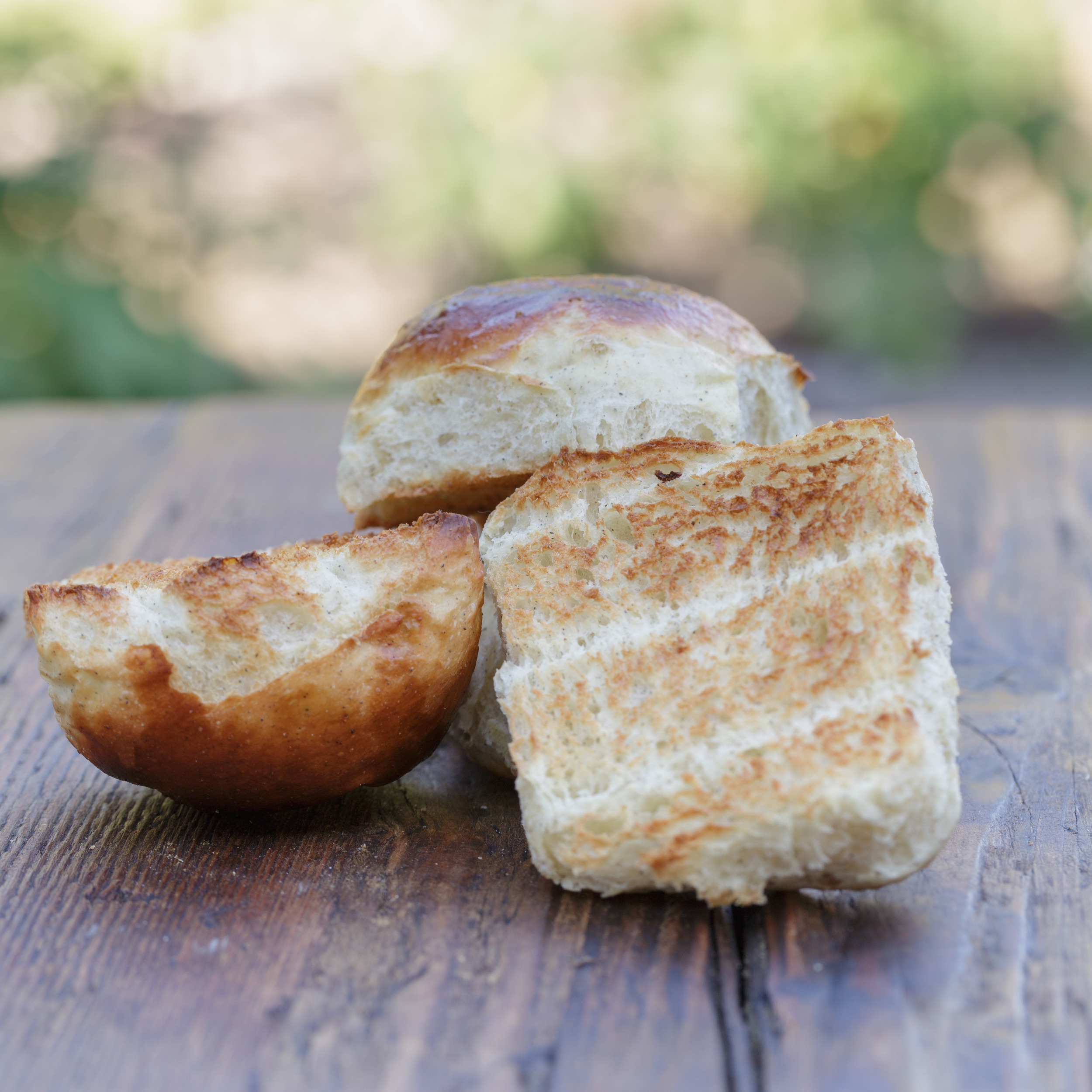
Hveder, or hvedeknopper, is a white bread roll spiced with cardamom. It's an old tradition from 1686 to eat heated rolls the night before "Store Bededag" aka "Prayers day." Store Bededag is the fourth friday after Easter, this year it's May 16th.  Actually it's a consolidation of a bunch of prayer and pendance days. Everybody had the day off on Store Bededag even the bakers. You were actually meant to stop all work, play, travels and all games. To make up for not being able to get any fresh bread on Store Bededag, the bakers made an abundance of hvedeknopper (wheat rolls), to tie people over. And the tradition of eating the toasted hvedeknopper the night before Store Bededag was born. Ok people was meant to save the rolls to the next day, but who can resist a fresh-baked roll?

The tradition stayed but nowadays the day is one of days used for the confirmation of the young people in the church - a big day for family parties.

Makes 18-20 hvedeknopper

Ingredients:

  • 50 g confectionary sugar

  • 10 g salt

  • 50 g live yeast (4 teaspoon dry yeast)

  • 1 egg

  • 75 g butter, room temperature

  • 5-10 g cardamom

  • 2½ dl (1 cup +1tablespoon) water, finger-warm

  • 550-600 g all-purpose flour

Directions:

In a large bowl dissolve the yeast in the water. (Add a teaspoon sugar if you are using dry yeast, and wait until it starts to foam.) Mix in the butter, sugar and egg. Add salt and cardamom to a small part of the flour, and add that to the water-mixture. Add the flour a little at a time, until you have a soft dough. You might not need it all. Knead the dough for about 7-10 minutes until the dough is shinny and elastic. Let the dough rise covered for about 20 minutes.  

Hveder - Hvedeknopper

Hveder - Hvedeknopper

Pour the dough onto a lightly floured workspace, fold the dough over 3-4 times and divide the dough into 18-20 small balls. Place the balls only about 1 cm (about ⅓-½ inch) apart on a parchment paper lined baking sheet. Cover the dough balls with a dampen kitchen towel, and let them rise for another 60 minutes. They are meant to grow into each other, you want the soft sides on your rolls, when you pull them apart.

Preheat the oven for 400℉ (200℃).

Bake the hvedeknopper/rolls for 15-20 minutes until they are dark golden brown. Let them cool on a wire rack.

Before serving, cut them in half and toast them. Serve them hot with butter and jam or with a good cheese.

Enjoy!


The Danish version:

Hveder - Hvedeknopper

18-20 stk.

Ingredienser:

  • 50 g flormelis

  • 10 g salt

  • 50 g gær (4 tsk tørgær/11,8 g)

  • 1 æg

  • 75 g smør

  • 5-10 g kardemomme

  • 2 ½ dl lunkent vand

  • 550-600 g mel

Fremgangsmåde:

Opløs gæren i vandet. Hvis du bruger tørgær, kom en smule sukker i vandet og vent et par minutter indtil gæren skummer. Tilsæt smør, flormelis og æg, og rør det sammen til det er blandet godt sammen. Bland kardemomme og salt i lidt af melet og tilsæt det til vandet. Tilsæt resten af melet lidt ad gangen og ælt dejen indtil den er blank og elastisk, ca. 6-10 minutter. Lad dejen hæve tildækket et lunt sted ca i 20 minutter.

Form 20 boller som sættes tæt på en bageplade med ca. 1 cm afstand. Læg et fugtigt viskestykke over og lad dem efterhæve i ca 1 time. Bag hvederne ved 200℃ i omkring 15-20 minutter, indtil de er mørk gyldne. Lad hvederne køle af på bagerist.

Før serveringen flæk hvederne og rist dem i en brødrister eller i ovnen med skærefladen opad ved 230 grader i ca. 5 minutter.

Server hvederne med koldt smør og marmelade eller en god ost.

Velbekomme!

Source: Lagkagehuset

Pizza Dough

Bread, DinnerTove Balle-PedersenComment
Breakfast Pizza and a hungry Gizmo

Breakfast Pizza and a hungry Gizmo

We like to bake our own pizzas (ok, they are called pizze in plural). But to bake your own pizza, you need a good pizza dough. I have tried several through the years, but no one has given me a better crust than the one from kvalimad.dk

Kvalimad, has different options depending on how good you are to plan ahead, but I really like his start in the morning dough. 

10 hour pizza dough

Makes 4 thin crust pizze.

Ingredients:

  • 625-650 g all-purpose flour
  • 450 ml (17/8 cups) water 
  • 50 ml olive oil
  • 2 teaspoons (14 g) salt
  • 3 g live yeast or about ¼ teaspoon dry yeast

Directions:

Dissolve the yeast in the water, if using dry yeast sprinkle a few pinches sugar in the water too. Add the rest of the ingredients and knead the dough for about 5 minutes in a stand mixer. (Knead a little longer if kneading by hand). The dough should now be somewhat sticky and elastic. 

Cover the bowl with plastic wrap and let the dough rise for about 8 hours on the kitchen counter.

Pour the dough onto a lightly floured workspace, fold the dough over 3-4 times and divide the dough into 4 rounds 

Sprinkle the rounds with flour and let them rise for another 2 hours, covered.

Now the dough is ready to use. 


The One Hour Dough

Makes 4 thin crust pizze.

This dough works, but it won't have the same crust and flavor, but it's still better than a frozen pizza from the grocery store.

Ingredients:

  • 625-650 g all-purpose flour
  • 450 ml (17/8 cups) water 
  • 50 ml olive oil
  • 2 teaspoons (14 g) salt
  • 1 tablespoon vinegar
  • 12 g live yeast or about 3 g dry yeast

Directions:

Dissolve the yeast in half of the water in the bowl of the stand mixer. If using dry yeast sprinkle a few pinches sugar in the water too.

Bring the rest of the water to a boil. Add oil, salt and vinegar to the bowl with half of the flour. Mix in half of the hot water. Add the rest of the flour and knead the dough for about 10 minutes in the stand mixer. Put the hot water into the mixing bowl for the stand mixer. (Knead a little longer if kneading by hand). The dough should now be somewhat sticky and elastic. 

Cover the bowl with plastic wrap and let the dough rise for about 30 minutes on the kitchen counter.

Pour the dough onto a lightly floured workspace, fold the dough over 3-4 times and divide the dough into 4 rounds 

Sprinkle the rounds with flour and let them rise for another 30 minutes, covered.

Now the dough is ready to use. 

Source: Kvalimad.dk

Basic Country Bread a la Tartine

Bread, Brunch, BreakfastTove Balle-Pedersen4 Comments
Basic Country Bread a la Tartine

Basic Country Bread a la Tartine

I finally got around to get Chad Robertson's Basic Country Bread on the blog, it only took 6-7 months.

Here goes:

Ingredients:

Leaven:

  • 1-2 tablespoons sourdough

  • 200 g water (78℉/25℃)

  • 100 g all-purpose flour

  • 100 g whole wheat flour

Bread:

  • 700 g water (80℉/27℃) + 50 g

  • 200 g leaven

  • 900 g all-purpose flour

  • 100 g whole wheat flour

  • 20 g salt

Sprinkles:

  • rice flour

Equipment:

Directions:

Make the Leaven:

The night before you plan to make the dough, put the matured sourdough from your refrigerator in water, and add flours. Mix well so you don't have any lumps of dry flour. Cover with a tea towel. Let rest on the counter for 8-10 hours. To test leaven's readiness, drop a spoonful into a bowl of room-temperature water. If it sinks, it is not ready and needs more time to ferment and ripen. If it floats, it's ready to use. As it develops, the smell will change from ripe and sour to sweet and pleasantly fermented.

Make the Dough:

Pour 700 grams warm water into a large mixing bowl, add 200 grams leaven, stir to disperse. (Save your leftover leaven.  It will be your starter/sourdogh for next time you bake.) Add flours  and mix dough with your hands until no bits of dry flour remain. Let rest covered with a tea towel on your counter for 30 minutes. Add salt and remaining 50 grams warm water. Transfer to a medium plastic container or a glass bowl. Cover with kitchen towel. Let rest for 30 minutes.

Folding:

The dough will now begin its first bulk fermentation (rise), to develop flavor and strength. The rise is temperature sensitive. As a rule, warmer dough ferments faster. Robertson tries to maintain the dough at 78℉ to 82℉ to accomplish the bulk fermentation in 3 to 4 hours. (Normally It takes 3 hours at my house, even when I have the air-con on.)

Instead of kneading, Robertson uses a folding technique to develop the gluten structure in the dough. Fold dough, repeating every 30 minutes for about 2½ to 3 hours. To do a fold, dip 1 hand in water to prevent sticking. Grab the underside of the dough, stretch it out, and fold it back over itself. Rotate container one-quarter turn, and repeat. Do this 2 or 3 times for each fold. After the 3 hours, the dough should feel aerated and softer, and you will see a 20 to 30 percent increase in volume. If not, continue bulk fermentation for 30 minutes to 1 hour more.

Pull dough out of container using a dough spatula onto an unfloured surface. Lightly flour the surface of the dough and use a bench knife to cut the dough into 2 equal pieces. As you cut the first piece, use the bench knife to flip it, so the floured side now rest on the work surface. Do the same with the second piece of dough.

Working with the dough you want to incorporate as little flour as possible. Work each piece into a round using scraper and 1 hand. Tension will build as the dough slightly anchors to the surface as you rotate it. By the end, the dough should have a taut, smooth surface. Dust tops of rounds with flour, cover with a tea towel, and let rest on the work surface for 20 to 30 minutes. During this stage, (bench rest), each round will relax and spread into a thick pancake shape. The edges should appear fat and rounded, not flat or "dripping" of the edge. if the dough is flat or the dough is spreading too much, the dough has not developed enough strength during the bulk fermentation. To correct this, shape the dough into a round a second time and let it sit to rest covered once more. 

 The final shaping:

To form the loafs, carefully place a dough round onto a lightly floured surface with the floured side down, using the bench knife. Now the underside is facing up.

Be careful not to deflate the dough. This final shaping builds up tension inside each loaf, so it holds it's form and rises substantially when baked. This is called "oven spring."

Fold the third of the dough closest to you up and over the middle third of the round. Stretch out the dough horizontally to your right and fold this right third over the center. Stretch the dough to your left and foldt this third over the previous fold. You are now starting to get a neat package. Stretch out the third of the dough farthest from you and fold this flap toward you, over the previous folds, and anchor it in place with your fingers. Then grab the dough nearest to you and wrap it up and over, while rolling the whole package away from you, that the smooth underside of the loaf now is on the top and all the seams are on the bottom. Let the shaped loaf rest on the counter for a minute. Fold the other loaf the same way.

Line 2 baskets with clean tea towels; generously dust with rice flour. Using the dough scraper, transfer each round to a basket, smooth side down, with seam centered and facing up. Let rest at room temperature (75℉ to 80℉), covered with towels for 3 to 4 hours before baking.

Baking the Bread:

Twenty minutes before you are ready to bake the bread, preheat oven and  dutch/french oven to 500 degrees, with rack in lowest position.

Flip one bread into heated dutch/french oven. Score top twice using a razor blade matfer lame. Cover with lid. Return to oven, and reduce oven temperature to 450℉. Bake for 20 minutes.

Carefully remove lid and continue to bake until crust is deep golden brown, 20 to 25 minutes more.

Transfer loaf to a wire rack. It will feel light and sound hollow when tapped. Let cool.

To bake the second loaf, raise oven temperature to 500 degrees, wipe out dutch/french oven with a dry kitchen towel, and reheat with lid for 10 minutes.

Focaccia

Bread, Brunch, DinnerTove Balle-PedersenComment
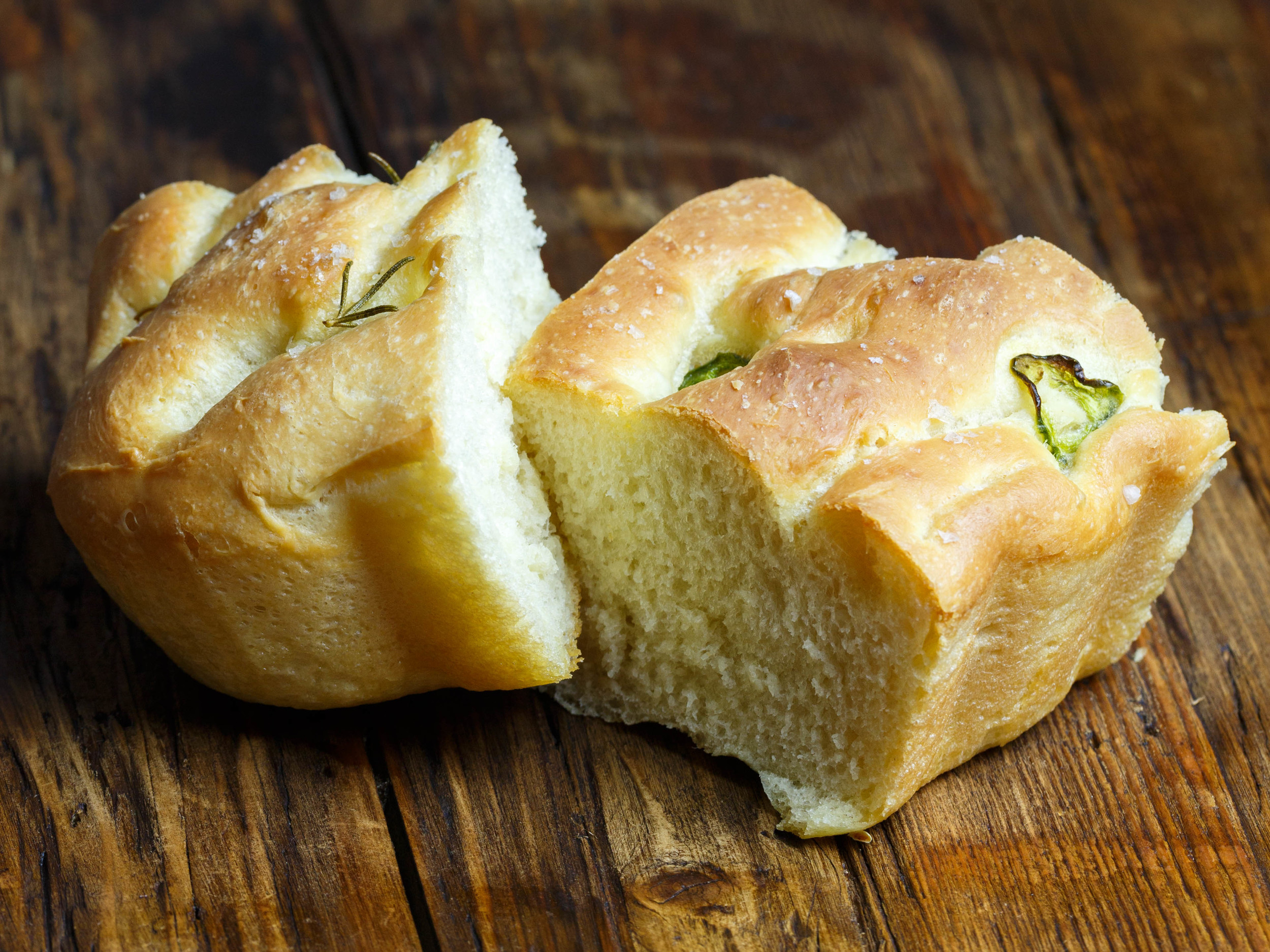
Focaccia - I should have used a larger baking pan, because the bread came out to high.

Focaccia - I should have used a larger baking pan, because the bread came out to high.

I love bread, most kind of bread, but I know its not good for me to just munch on. Anyhow I bought a pound of live yeast, so I have to bake bake bake. 

Focaccia has always been a bread I wanted to try to make, but I have never got around to it. Now was the time. 

I like the crispy top on the soft, salty flavorful bread. I looked up a bunch of recipes and made a concoction. 

Ingredients:

  • 3,25 dl water finger-warm
  • ½ dl olive oil
  • 10 g live yeast
  • 500 g all-purpose flour or a high protein flour. 
  • 10 g sea salt

Toppings:

  • sea salt
  • olive oil
  • rosemary like spices (or jalapeño)

Directions:

Dissolve the yeast in the water. Add a teaspoon sugar if you are using dry yeast, and wait until it starts to foam. Add the oil. 

Mix the salt with the flour and mix it in to the wet ingredients. 

If you knead the dough by hand, knead it for 12-15 minutes. 

If you knead it in a stand mixer, mix it for 3 minutes at low and then 8-10 minutes on high. 

The dough should be sticky. 

Let the dough rise in the bowl covered by a tea towel for about 3 hours. 

Grease your baking pan with olive oil. Pour the dough into the pan and press the dough with your fingers to spread it out and get the wells for the spices and oil. 

Pour a good olive oil on top and sprinkle with coarse sea salt and rosemary. Press salt, oil and rosemary into the dough with your finger. 

Let the focaccia sit to rise for 45 minutes before baking it for 20-25 minutes at 440℉ (220℃).

Let the bread cool in the pan before serving.