Sweet • Sour • Savory

Food blog on scandinavian style food done right.

Cake

Kransekage with orange zest or chocolate

Cake, Holiday, Sweets and Candy, New Year's EveTove Balle-Pedersen2 Comments
Kransekage with orange zest and chocolate

Kransekage with orange zest and chocolate

When I make kransekage for New Year's Eve, I always make small pieces with different flavor profiles. The classic with the danish nougat, a soft chocolate made with hazelnuts. Another flavor profile I really love is with orange zest.

Kransekage: 

  • 50 g almonds blanched

  • 100 g sugar

  • 1 egg white

  • 250 g marzipan (I used Ren Rå, a 60% almond paste)

  • zest of 1 orange or

  • 15 g nougat (the golden package on the photo)

Icing:

  • confectionary sugar

  • water

Directions:

Put almonds and sugar into food processor with the steel blade in place and process until finely pulverized. Add the egg whites and process until smooth. Be careful not to heat the mass to more than 95 - 104°F, else the egg white will cook. 

Shred the marzipan and add it and the almond/egg white mixture to a stand mixer fitted with the paddle attachment. Beat it until it's completely smooth and free of lumps. Form the dough into a ball, and refrigerate for 2-3 hours.

Preheat oven for 375℉ (190℃).

If you make the one with orange zest, add it when you mix the batter.

Roll the dough into logs as thick as your finger, and cut into 3 inch long pieces. Press the top part, making a top. 

For the ones with nougat, cut about 1 inch of the pieces. Roll the 2 inch thinner, and flatten the log, and form a little slit where you put some of the nougat. Top the piece of with the rest of the dough you cut of.

Bake for about 12 minutes or until golden.  Allow to cool completely before icing them.
 

Kransekage - Danish Almond Cake

Cake, Holiday, New Year's Eve, Sweets and CandyTove Balle-Pedersen5 Comments
Kransekage

Kransekage

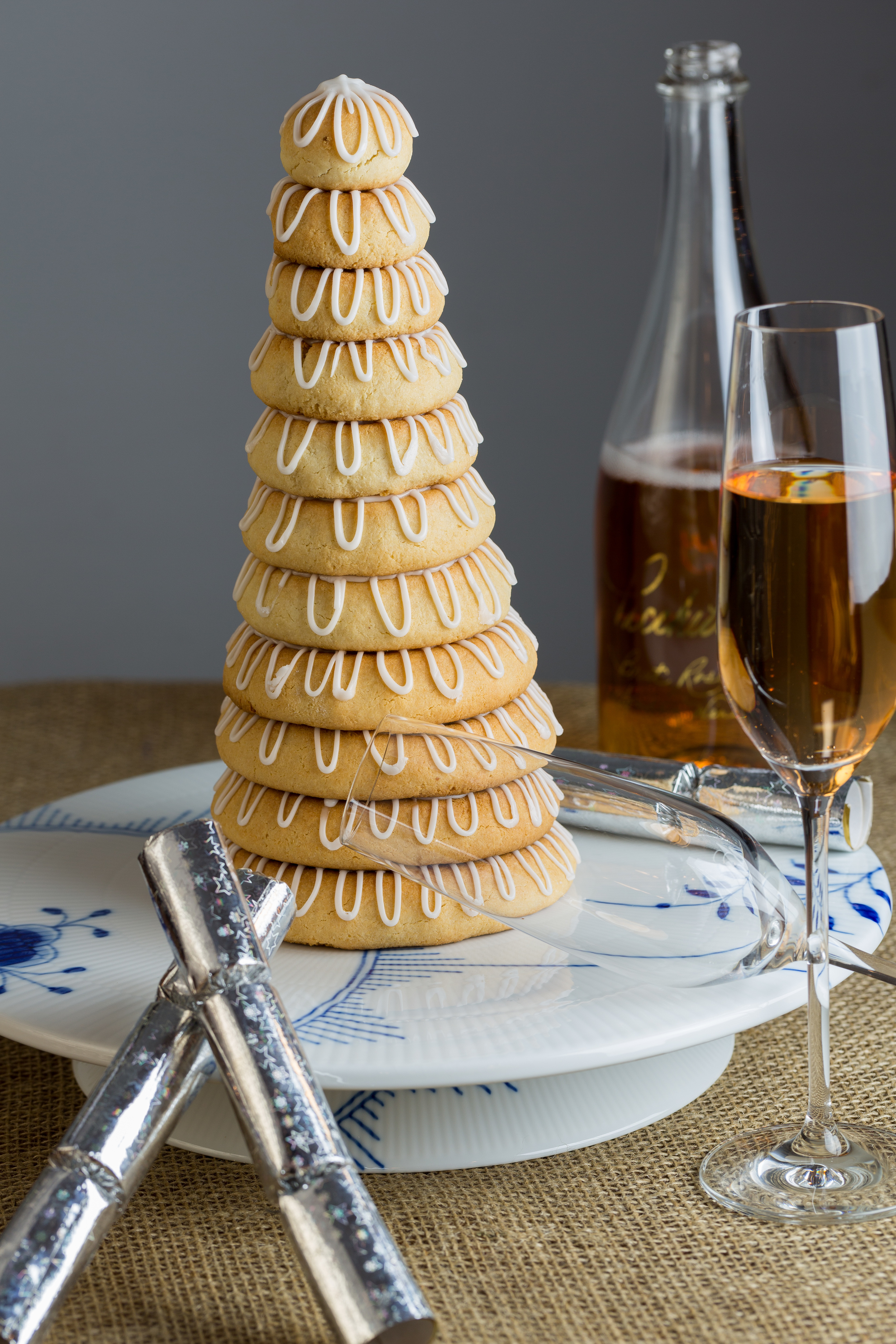
Kransekage is a traditional cake served at New Year's Eve at midnight with champagne, at weddings (back in the days) or at special occasions. I like kransekage with a  sweet champagne, because the sweetness of the cake makes the champagne very sour. Served with coffee it is actually perfect, but not very festive. 

Kransekage is made from Marzipan, an almonds paste, sugar, almonds and egg whites. 

Kransekage: 

  • 100 g almonds blanched or ¾ cup slivered almonds

  • 200 g (1 cup) sugar

  • 2 egg whites

  • 500 g marzipan (I used Ren Rå, a 60% almond paste)

Icing:

  • confectionary sugar

  • water

Directions:

Put almonds and sugar into food processor with the steel blade in place and process until finely pulverized. Add the egg whites and process until smooth. Be careful not to heat the mass to more than 95 - 104°F, else the egg white will cook. 

Shred the marzipan and add it and the almond/egg white mixture to a stand mixer fitted with the paddle attachment. Beat it until it's completely smooth and free of lumps. Form the dough into a ball, and refrigerate for 2-3 hours.

Preheat oven for 375℉ (190℃).

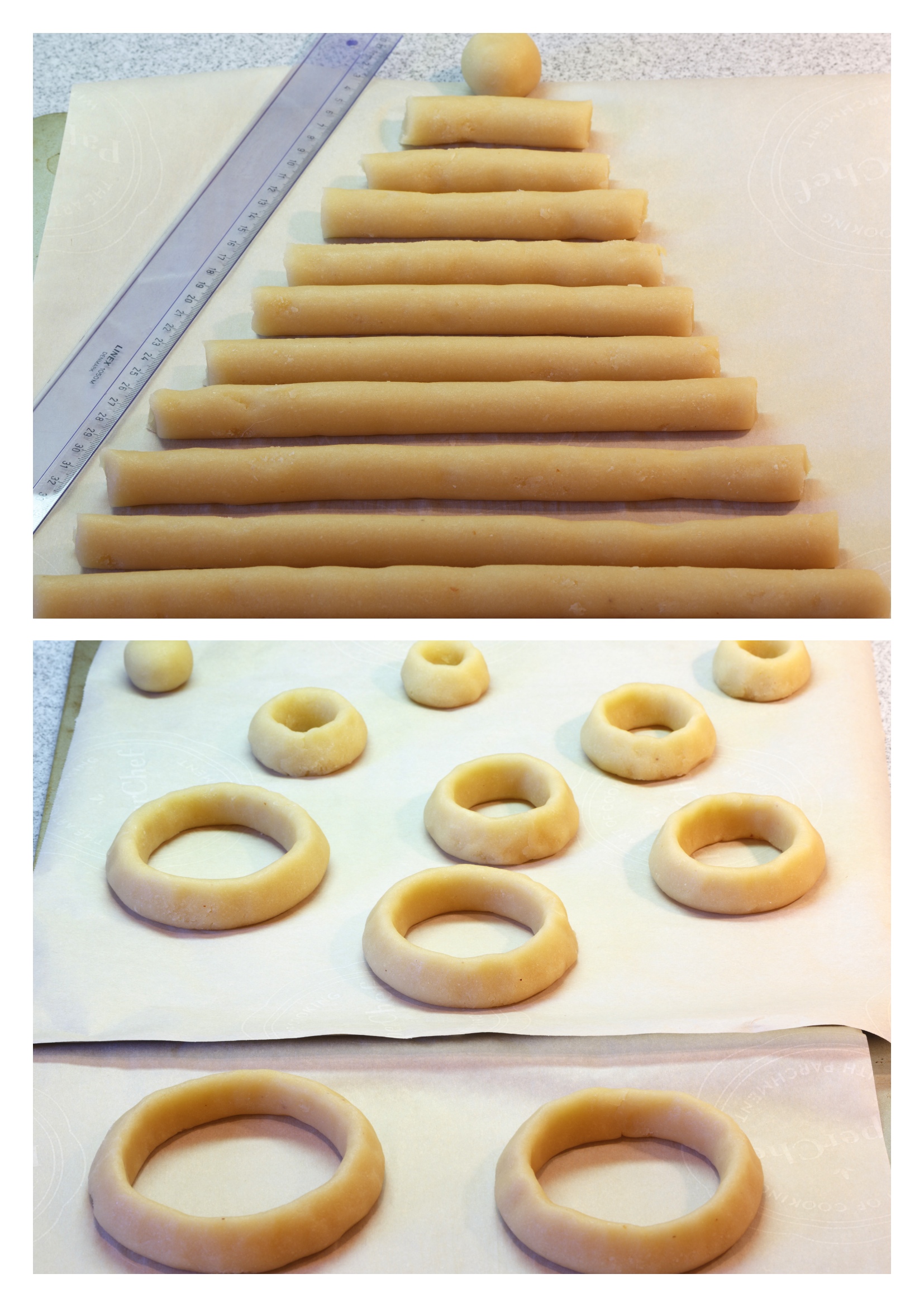
Divide dough in 4. Roll each part into a 45 cm (18 inch) long sausage. Wet your fingers with a little water and gently press each log into a rounded triangle, continue to wet fingers as needed but careful not to get dough too wet.

For a kransekage top you'll need these lengths: 

The process

The process

  • 7 cm (2 3/4 inches) to make the top ball.

  • 8 cm (3 1/6 inches)

  • 12 cm (4 3/4 inches)

  • 16 cm (6 1/3 inches)

  • 20 cm (7 7/8 inches)

  • 24 cm (9 1/2 inches)

  • 28 cm (11 inches)

  • 32 cm (12 2/3 inches)

Form the rings on a baking sheet lines with parchment paper.  Level the top of the rings by putting a baking sheet on top. Don't press to hard.

Bake for about 12 minutes or until golden.  Allow to cool completely.

Put the icing on the baked rings. Start with the biggest. Make sure to put the next on top of it before the icing is dried. Or glue the rings together with small dots of icing.

Decorate the kransekage with flags and confetti. 

Notes: 

You can use tempered chocolate instead of the icing.  

Edit.

This year, I weighed opted for another approach.
Making a 10 tiered top, I used 4 X 165g of the dough and rolled then into 4 x45 cm logs. + 1 x 81 g for  one 22 cm log.

The logs were then cut into these lengths:

  • 8 cm

  • 10½ cm

  • 13 cm

  • 15½ cm

  • 18 cm

  • 20½ cm

  • 23 cm

  • 25½ cm

  • 28 cm

  • 30½ cm


Danish Coffee Cake - Drømmekage fra Brovst

CakeTove Balle-Pedersen2 Comments
Danish Coffee Cake

Danish Coffee Cake

Danish coffee cake or "Drømmekage from Brovst" is one of the most well known cakes in Denmark. We might be known for the danish, aka “wienerbrød," but most danes has had this cake at school, work or at family gatherings. In the 70's and 80's this coffee cake was the go-to cake for the danish at home-bakers, and rightfully so. The soft, moist and not overly sweet vanilla spongecake, topped with a coconut-caramel is so yummy and the cake will evaporate in any home.

The cake has it's roots in the 1950s in Northern Jutland, but became known all over the country in the early 1960s when the big flour-company published the recipe in a pamphlet. 

It's not only the taste that made this cake popular, it's so easy to make, so it's a good starting cake for non-bakers.

Ingredients:

Cake:

  • 4 eggs
  • 300 g sugar
  • 250 g all-purpose flour
  • 3 teaspoons baking powder 
  • 1 teaspoon vanilla paste
  • 200 g milk
  • 50 g butter

Topping:

  • 150 g butter
  • 225 g shredded unsweetened coconut
  • 340 g brown sugar
  • 75 g milk

Directions:

Preheat the oven to 425℉ (220℃).

Melt the butter in the milk in a little saucepan, set aside to cool until finger warm.

In a stand mixer whisk eggs with sugar until light and fluffy, about 5 minutes. Incorporate the vanilla paste.

Sift the dry ingredients and fold them gently into the egg mixture. Fold the milk/butter into the batter. 

Line a baking pan with parchment paper. Pour the batter into the baking pan. 

Bake cake for about 20 minutes or until a cake tester comes out clean. 

Make the topping, while the cake is in the oven. 

Heat milk, butter, sugar and coconut in a saucepan while stirring. 

As soon as the cake comes out of the oven, add the topping, being careful to distribute it in an even layer. Put the cake in the oven for another 4-6 minutes.

Let cake cool on a rack.

Enjoy with friends or family.


Lemon Scones

Cake, Brunch, Desserts, CookiesTove Balle-PedersenComment
Lemon Scone

Lemon Scone

It's really hard to find really good scones. They have to be flaky and soft. One of the only places you can get these in Copenhagen is at Reinh van Haun bakery. Well you can probably get real scones in the UK.

Recently I had a really god and flakey scone at Tartine Bakery & Cafe in San Francisco, but it's not just around the corner from here, so I won't be hanging out there a lot. But if you're ever in San Francisco stop by Tartine, even if you have to wait in line, It's worth the wait.

I got this recipe at a cooking class in Sur La Table from Chef Nikki B. Frias. I'm sad to see that she's no longer at the Los Gatos Store - I miss you Nikki! 

Makes 10-15.

Ingredients: 

  • 450 g all-purpose flour
  • 85 g sugar
  • 30 g baking powder
  • 7 g  salt
  • 115 g  cold unsalted butter, cut into 1/2 inch cubes
  • 475 ml heavy whipping cream
  • 1 tablespoon lemon zest

Topping:

  • heavy wipping cream
  • demerara sugar (raw cane sugar)

Directions:

Preheat oven to 400°F  (205°C) For a convection oven. Non-convection preheat oven to 425°F  (220°C) 

Mix all of the dry ingredients together in a bowl, by hand. Add the butter. I used a pastry cutter to incorporate the butter in the flour mixture. Mix until the the butter resembles small pebbles.

Getting ready for the oven.

Getting ready for the oven.

Add in your cream and lemon zest and mix until it just comes together and resembles biscuit dough. This step is very important because if you over mix, the dough will become dense. If you use berries in the scones, add them now


Using an ice cream scoop, take the scones dough and place the dough onto a parchment lined baking sheet.
Brush the top with heavy whipping cream and sprinkle with sugar.


Bake for approximately 10-15 minutes, or until golden brown in the mottle of the oven.

Note: 

You can make the dough and set them on a baking sheet and then freeze them in advance. When you want fresh baked scones - just take the frozen scones out and brush the top with heavy whipping cream and sprinkle with sugar, and bake. No need for defrosting.

You can add fruit to the batter. Use about 115 g, but don't use strawberries, they contain to much water. 

Danish Hindbærsnitter

CakeTove Balle-Pedersen4 Comments
Hindbærsnitte.

Hindbærsnitte.

Hindbærsnitter or 'raspberry bars' is a cake made of a shortcrust pastry, like the one you will use for a pie crust. Between the two layers of pastry there's a filling of a good raspberry jam. The cake is topped with an icing and colorful sprinkles.

You'll find hindbærsnitter in almost every bakery shop in Denmark. The quality may varies greatly, mostly because the bakeries doesn't make hindbærsnitter daily.

Hindbærsnitter has been one of my favourite cakes growing up. Even though that I, as an adult, don't like cakes to sweet, these hindbærsnitter will always be have a special place in my cake loving heart.<3

When you make these you'll find out that they won't keep, they will evaporate! 


Ingredients:


Pastry:

  • 2 teaspoon vanilla paste

  • 75 g confectionery sugar

  • 150 g butter, room temperature

  • 250 g All-purpose flour

  • 1 teaspoon baking powder

  • 50 g water (1/2 dl)

Filling:

  • 200 g raspberry jam, in a good quality


glaze:

  • 225 g confectionary sugar

  • a little bit water

Topping:

  • colorful sprinkles

Directions: 

Pastry:

Using a stand mixer with paddle attachment, mix together sugar, flour, butter, vanilla paste and baking powder. When the butter is mixed in well add the water, a little at a time, you might not need all of it. Be careful not to over mix the dough. Wrap the dough in plastic wrap and refrigerate dough for about 30 minutes.  

Rolling out the dough and when it's baked.

Rolling out the dough and when it's baked.

 Generously flour your counter, then place the chilled, unwrapped dough on the flour and flour the top of the dough. Roll you dough into a 8x12-inch (20x30 cm) rectangle. Re-flour your surface as needed, continually lifting and rotating your dough to make sure no parts are sticking. Lift the dough on to a parchment paper lined baking sheet. Cut the dough to a perfect rectangle and down the middle, so you get two 4x12-inch pieces.  Bake them at 400°F (200°C) for 10-12 minutes. They should be very light browned and look a bit undercooked. Cool the cakes completely. My rectangles were a bit to brown, an cracked a bit when I sliced them.

Spread an even layer of raspberry jam on one of the rectangles, put the other one on top to make a sandwich.  

Put the confectionary sugar in a pot over low heat. Slowly heat the sugar and add water until it becomes a thick paste. The icing should not be hot, just a bit warm, so it will dry quicker. Spread a thin layer of the icing on the sandwiched cake, and put sprinkles on top. Slice the cake into the desired size with a sharp knife. The cake tends to break a bit in this process if the cake is baked too much.

Serve the cake with a cup of the or coffee.