Sweet • Sour • Savory

Food blog on scandinavian style food done right.

Sourdough Bread with Olives

Bread, Breakfast, BrunchTove Balle-PedersenComment
Sourdough Bread with Olives

Sourdough Bread with Olives

It’s no secret in my neighborhood that I love to bake. So now and then a neighbor nudge me to bake some bread. So in honor of my olive-loving neighbor, I tried a, for me, new filling for my sourdough breads - olives. Prior to this I’ve used artichoke/parmesan or walnuts with big success. So even though I still love the walnut one very much, the olive bread comes in as a very close second. It’s really good!!

But if you are the type of person that love nutella or pålægschokolade (thin slices of chocolate, used on bread in Denmark) this bread will not be the best option for you. But if you are a chocolate covered olives kind og guy - well go right ahead.. 😂

This bread is great to have with cheese, cold cuts, soups or simply with some butter.

Makes 2 breads.

Ingredients:

Leaven:
875E9078-62E1-43E4-89B2-E44B1C31D187_1_201_a.jpeg
  • 3 tablespoons sourdough starter (fed 8 hours prior)

  • 200 g water (78℉/25℃)

  • 100 g all-purpose flour

  • 100 g whole wheat flour

Bread dough:

  • 720 g water (80℉/27℃)

  • 250 g leaven

  • 800 g all-purpose flour

  • 200 g whole wheat flour

  • 20 g salt

  • 50 g water

Filling:

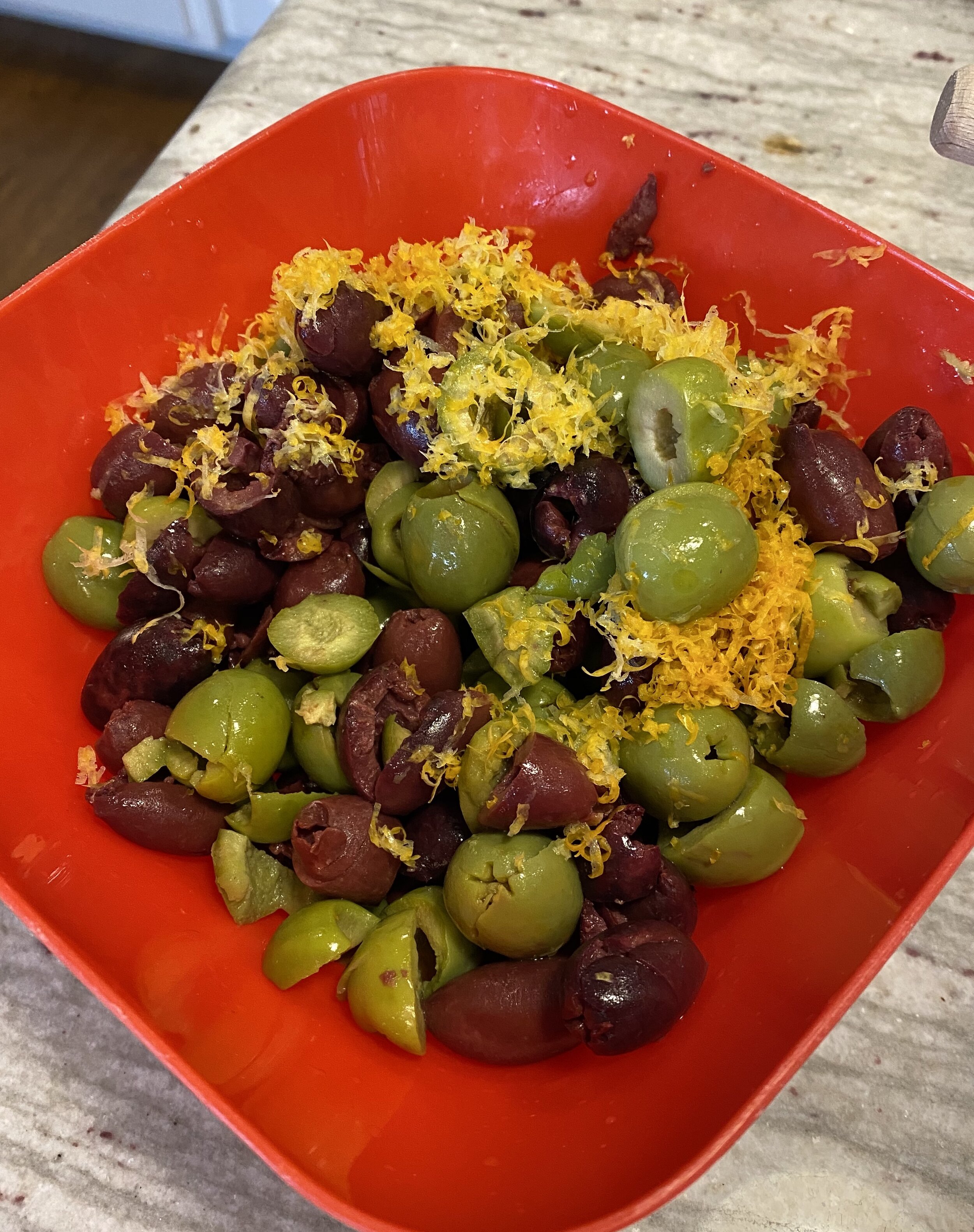
  • 375 g pitted olives, I used ⅓ green olives

  • zest of 2 lemons

Sprinkles:

  • rice flour

Directions

Prepare the Leaven - 8am day 1.

The man in the cup - testing the readiness of the leaven. Here you see it floating on the water.

The man in the cup - testing the readiness of the leaven. Here you see it floating on the water.

Mix the ingredients in a medium bowl, and let it sit covered on the kitchen counter for 7-8 hours. To test leaven's readiness, drop a spoonful into a bowl of room-temperature water. If it sinks, it is not ready and needs more time to ferment and ripen. If it floats, it's ready to use.

Save your leftover leaven.  It will be your starter/sourdogh for next time you bake. Read here how to feed and keep a sourdough starter.


Mixing the dough - 5pm day 1.

Pour the warm water into a large mixing bowl, adding leaven, stir to disperse. Add flours and mix dough with your hands until no dry flour remain. Let rest covered with a tea towel on the counter for about 30 minutes. Mix in salt and remaining 50 grams warm water with your hands. Transfer the dough to a medium plastic container or a glass bowl. Cover with lid or kitchen towel. (I use a dough-rising bucket like this.)

I use the folding technique from the basic country bread a la Tartine during the fermentation. Instead of kneading the dough, I stretch and fold the dough, by reaching my hand under the dough and pull one side up and over onto itself. This will help build up the gluten network. The rise is temperature sensitive. As a rule, warmer dough ferments faster. Robertson tries to maintain the dough at 78℉ to 82℉ to accomplish the bulk fermentation in 3 to 4 hours. I ferment my dough in my oven on the proof setting, 85℉/29.5℃. I add the filling during the folding, by adding a little at a time, so the distribution will be evenly.

Do the fold every 30 minutes during the 3 hours.


Shaping the dough - 8-9 pm day 1.

Gently pull the dough out of container, onto an un-floured surface, using a dough spatula. Lightly flour the top of the dough and use a bench knife to cut the dough into 2 equal pieces. As you cut the first piece, use the bench knife to flip it over, so the floured side now rest on the work surface. Do the same with the second piece of dough.

While working with the dough you want to incorporate as little flour as possible. Work each piece into a round using scraper and one hand. Tension will build as the dough slightly anchors to the surface as you rotate it. By the end, the dough should have a taut, smooth surface. Dust tops off rounds with flour, cover with a tea towel, and let rest on the work surface for 20 to 30 minutes. During this stage, (bench rest), each round will relax and spread into a thick pancake shape. The edges should appear fat and rounded, not flat or "dripping" off the edge. If the dough is flat or the dough is spreading too much, the dough has not developed a strong enough gluten network during the bulk fermentation. To correct this, shape the dough into a round for a second time and let it sit to rest covered once more.

The final shaping:

To form the loaf's, carefully turn the dough onto a lightly floured surface with the floured side down, using the bench knife. Now the underside is facing up. Be careful not to deflate the dough. This final shaping builds up tension inside each loaf, so it holds its form and rises substantially when baked. This is called "oven spring."

Fold the third of the dough closest to you up and over the middle third of the round. Stretch out the dough horizontally to your right and fold this right third over the center. Stretch the dough to your left and fold this third over the previous fold. You are now starting to get a neat package. Stretch out the third of the dough farthest from you and fold this flap toward you, over the previous folds, and anchor it in place with your fingers. Then grab the dough nearest to you and wrap it up and over, while rolling the whole package away from you, that the smooth underside of the loaf now is on the top and all the seams are on the bottom. Let the shaped loaf rest on the counter for a minute. Fold the other loaf the same way.

Line two baskets with clean tea towels generously dusted with rice flour. These bowls will hold the fermenting dough overnight in the fridge to proof. Using the dough scraper, transfer each round to a basket, smooth side down, with seam centered and facing up. Cover the dough loosely with tea towel, and place it in a large ziplock bag - do not close the bag. Let the dough rest in the refrigerator overnight.

Baking the Bread - day 2.

Pull the loves out of the refrigerator, removing the bowls from the ziplock bag. Let the bowls on the kitchen counter while you preheat the oven and dutch/French oven to 500℉ (260℃), with rack in lowest position.

Flip one bread into hot dutch/french oven. Score top twice using a razor blade matfer lame. Cover with lid. Return to oven, and reduce oven temperature to 450℉ (232℃). Bake for 20 minutes.

Carefully remove lid and continue to bake until crust is deep golden brown, 20 to 25 minutes more.

Transfer loaf to a wire rack. It will feel light and sound hollow when tapped. Mix the topping and spread it on top of the hot crust, then let the loaf cool. Letting the bread cool, is the hardest thing.

To bake the second loaf, raise oven temperature to 500℉ (260℃), wipe out dutch/French oven with a dry kitchen towel, and reheat with lid for about 10-20 minutes.

Enjoy!

A look inside.

A look inside.

Green Pepper Sauce

Dinner, SauceTove Balle-PedersenComment
Green Pepper Sauce

Green Pepper Sauce

503D4CA1-4DAB-4EAF-8E42-4A0314EAD808_1_201_a.jpeg

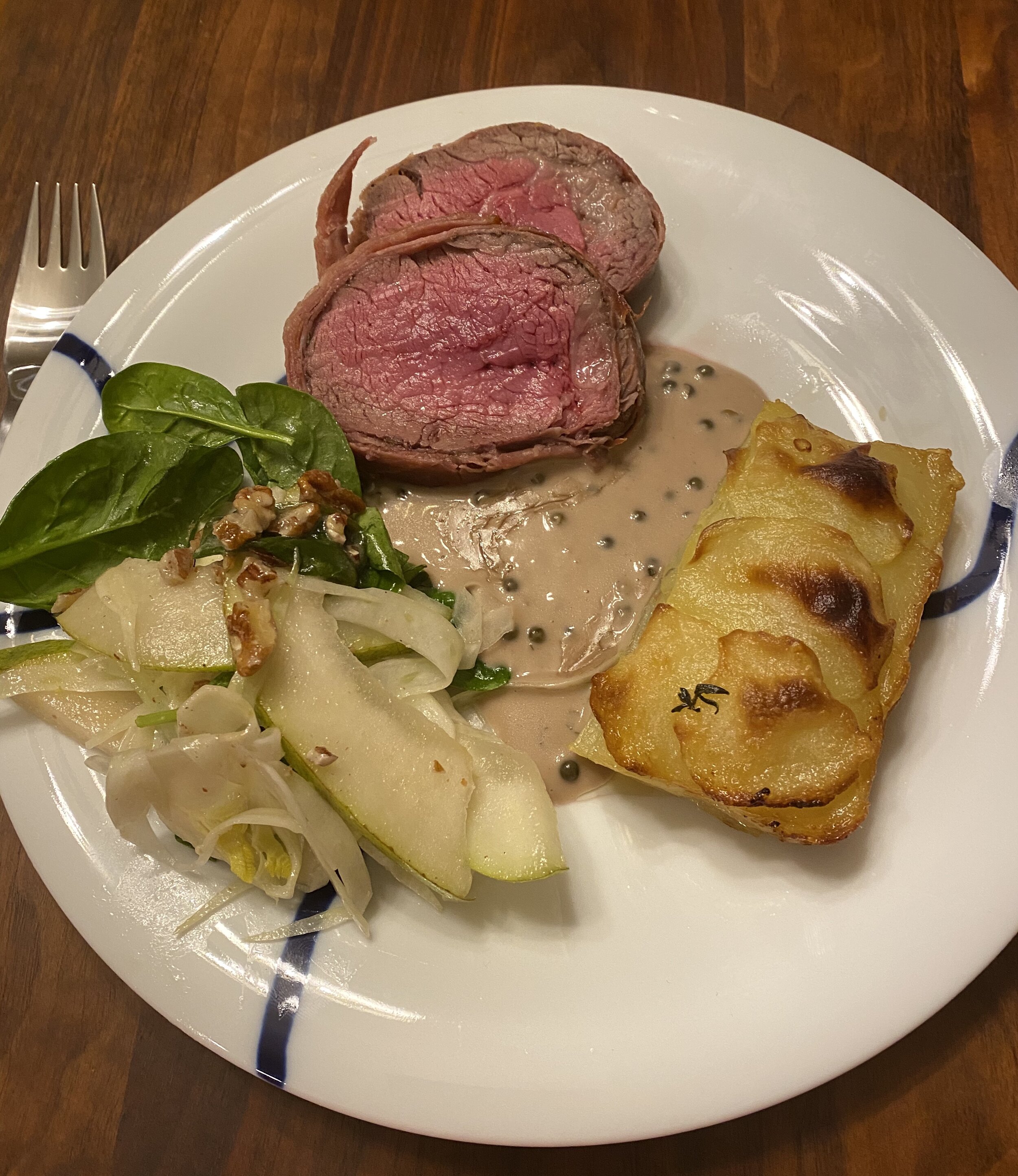
This green pepper sauce is a tasty but spicy sauce that pairs well with beef. You often get this type of sauce at steakhouses, and this is one of my favorites. In Denmark I’d never made it from scratch, I would just buy the Knorr powder version. But of course the real deal is so much better, so much worth the time and effort. I like that you can make the sauce-base well in advance, you can even freeze it.

This year we had green pepper sauce for our New Year’s dinner, and as a sauce loving creature it was front and center on my plate.😂

Serves 6-10.

Ingredients:

  • 1 shallot, chopped

  • ⅛ root celery, diced

  • 1 garlic clove

  • 2 teaspoons green peppercorn in brine (Madagaskar peppercorns), chopped

  • 1 teaspoon butter

  • 1 teaspoon grape seed oil (or another flavorless oil)

  • 50 ml Cognac

  • 250 ml beef stock

  • 200 ml red wine

  • 1 sprig rosemary (leaves only)

  • 3 sprigs of fresh thyme

  • 1 splash of Gastrique ( you can replace this with some sugar and a splash of vinegar)

  • 100 ml heavy whipping cream

  •  salt to taste

  • 2 teaspoons green peppercorn in brine (Madagaskar peppercorns)

  • Cornstarch - optional, mixed in cold for thickening

Gastrique (Adapted from Bobby Flay)

  • 1/4 cup (80g) honey

  • 1/2 cup (125ml) apple cider vinegar

Directions:

Gastrique (Adapted from Bobby Flay)

Heat the honey in a small saucepan over medium-low heat for 5 minutes, until it becomes deep golden brown. Add the vinegar and continue to cook, swirling the pan a few times - do not use a spoon. Cook it for about 15 minutes, until the honey/caramel is incorporated in the vinegar, and the gastrique has thickened to the consistency of thin maple syrup. Remove from heat. Keep the gastrique in a sealed sterilized bottle in the refrigerator, it will keep for months.

Sauce:

Sauté onions, celery root, garlic and the chopped peppercorns until the onions are translucent. Remove saucepan from the heat, move the pan away from fan, actually do not have lamps or any other things above it. Pour in the cognac into the pan swirl it round, and standing at a safe distance from the pan, ignite it with a long match or lighter. Gently swirl/stir your now-flaming pan to evenly distribute the alcohol. Let cook until the flames disappear, and the alcohol vapor burns off by itself in a few seconds. Add the beef stock, red wine, rosemary, and thyme. Let the sauce simmer for at least 30 minutes. Strain the now sauce-base through a sieve set over saucepan, pressing firmly on solids, getting all the good flavors out. Reduce the sauce-base to about half, you are aiming for a concentrated base. (All this can be made in advance).

Add cream, whole peppercorns and season the sauce with salt and gastrique. If you like a slightly thicker sauce, you can thicken it with some cornstarch dispensed in cold water. Serve the sauce with a nice steak or roast.

Enjoy!

Panettone French Toast

Breakfast, Brunch, Christmas, HolidayTove Balle-PedersenComment
Panettone French Toast

Panettone French Toast

The past few years we bought a panettone from Manresa Bread for Christmas. This traditional Italian Christmas bread is a mix between a bread and a cake. I’ve see the ones at the grocery stores for years, but it was first when I got interested in sourdough bread baking and saw the panettone at our Local Manresa Bread store, I wanted to try it. It is as yummy in the morning with coffee as it is in the afternoon with a glass of something sweet. But the panettone is a large bread/cake, so I wanted to see if you could use the leftovers in another way, and here, French Toast a very good option. I do like French toast, but often it is very sweet and I find it to lack texture. But the panettone version add a more complex flavor profile and the breads own texture and the dried berries make it a very delicious breakfast. But I like a bit of salt with my sweets in the morning, so we added some bacon to our plates, and it was just perfect. when serving people with a larger appetite, add a sunny side up egg to the mix.

Serves 2.

Ingredients:

  • 1 large slice Panettone (1-inch/2-3 cm) thick (I used a ginger lemon cherry panttone from Manresa Bread)

  • 1 egg

  • 4 tablespoons heavy whipping cream

  • ½ teaspoon vanilla

  • 1 lemon, the zest of

  • 1 pinch salt

Directions:

723E7C65-4146-4C6A-8900-B4CCB369436E.jpeg

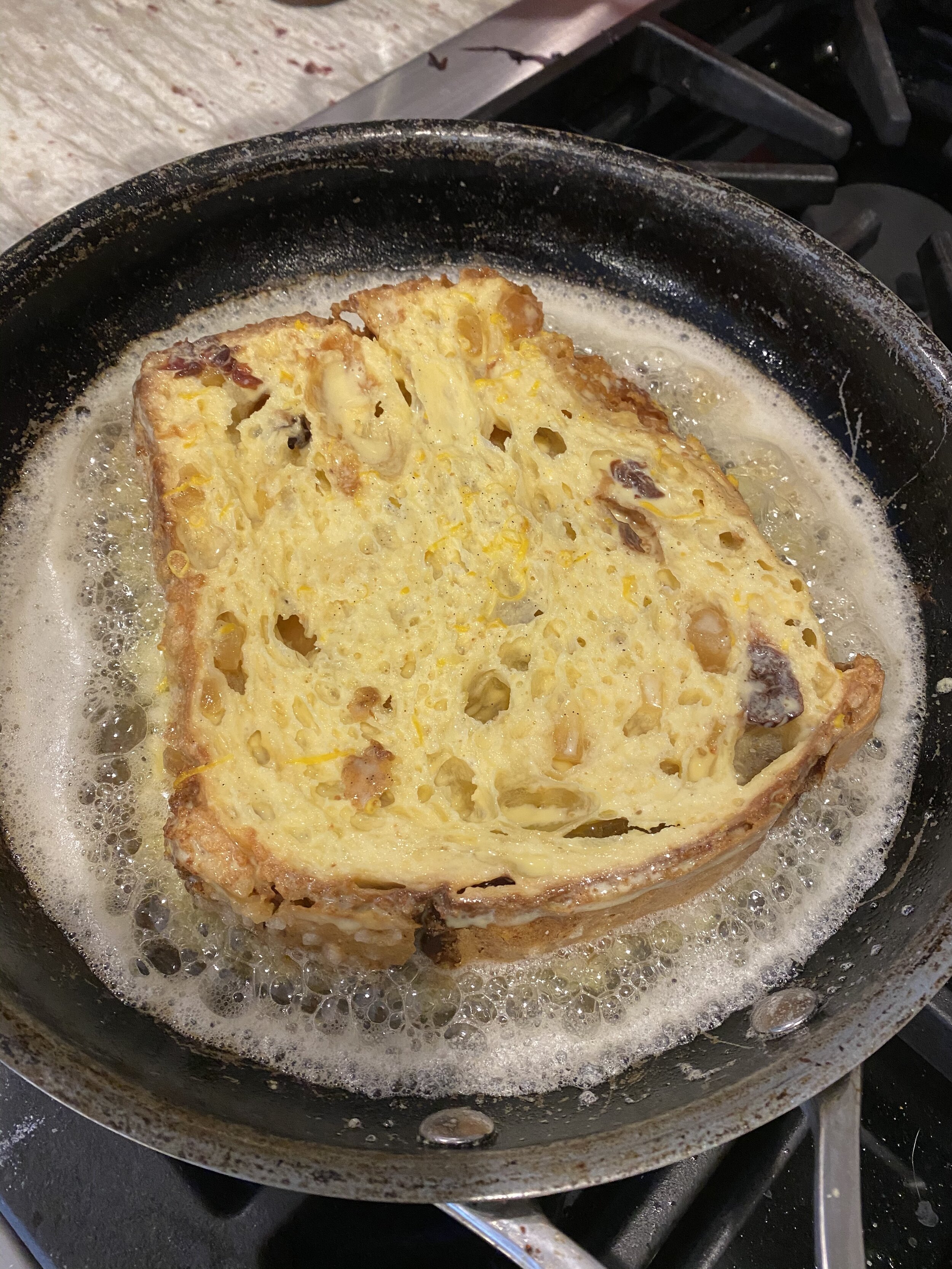
In a wide, shallow bowl, beat the egg, cream, vanilla, and salt together with a whisk until well-combined. Place the bread slice in the custard and gently press it down to help the bread absorb the custard, then flip it over and do the same to the other side of the bread. 

Heat a good amount of butter in a large skillet over medium heat. Add the custard-soaked bread to the pan and cook until it’s browned, it takes about a minute. Flip the bread and fry on the other side until it is browned. Serve the French toast immediately with a light sprinkle of powdered sugar and a drizzle of marble syrup. I served with a couple of slices of bacon, to bring some saltiness to the plate.

Enjoy!

Truffles with Orange Zest

Christmas, Holiday, Sweets and CandyTove Balle-PedersenComment
Truffles with Orange Zest (I used a cutie for the photo, I was all out of oranges.)

Truffles with Orange Zest (I used a cutie for the photo, I was all out of oranges.)

These truffles are melt in your mouth delicious. well they will melt in your hand too, so its a delicate chocolate. If you want them to be easier to handle when serving, you can use the truffle/ganache as a filling in chocolates, but may turn up the orange flavor a bit.

I used a cutie for the photo, I was all out of oranges.

Makes 20-30 small truffles.

Ingredients:

  • 175 ml heavy whipping cream

  • 175 g dark chocolate, I used Valrhona

  • 1 organic orange, the zest of

  • 1 tablespoon orange liqueur like Grand Marnier - optional

  • unsweetened cocoa powder, I used Valrhona

Directions:

Chop the chocolate finely, and set aside. Zest the orange, and set it aside. Line a small loaf pan with parchment paper, and set it aside.

Heat the cream to the boiling point in a small saucepan. Pour the hot cream over the chocolate and stir it until alll the chocolate is melted and the ganache becomes shining. Stir in the orange zest and liqueur. Pour the ganache into the prepared loaf pan and set in the refrigerator for 1-2 hours to firm up. Cut the truffles up in bite-size squares and cover them with cocoa powder. Store the truffles in an airtight container in the refrigerator.

Enjoy!

Is-a-la-mande - Ice Cream a la Risalamande

Christmas, Desserts, Holiday, Ice CreamTove Balle-Pedersen1 Comment
DSCF2219.jpg

This Ice cream is made to resemble the traditional Danish Christmas dessert Risalamande (Danish rice pudding). Some don’t like the risalamande (which I just can’t understand 🤷‍♀️😉), but making an ice cream should please most. I made this for a Danih Christmas Lunch this year. Adding 1 whole blanched almond, and the one who found the almond, got the almond-gift (mandelgaven) like with the normal risalamande. I think this was a great substitution.

Serves 8-10.

Ingredients:

Ice cream base:

  • 200 g sugar

  • 4 egg yolk

  • 1-2 teaspoons vanilla paste

  • 200 ml heavy whipping cream

  • 400 ml whole milk

Filling:

Cherry sauce:

  • 340 g (12 oz) frozen dark sweet cherries

  • 1 can Oregon dark sweet cherries in heavy syrup

  • 2 teaspoons vanilla bean paste

  • 100 g (½ cup) sugar

Directions:

Ice cream:

Warm milk and ½ of the cream in a saucepan. Pour the rest of the cream into a bowl over an ice bath. 

Whisk the egg yolks pale with the rest of the sugar, then whisk in the vanilla. Add the hot milk in a little at a time, while whisking. Pour the mixture back in the saucepan. Slowly heat the mixture over medium heat while constantly stirring. You want the mixture to thicken slightly, but you don't want the mixture to come to a boil, this will coagulate the egg yolks. You do not want the mixture to exceed 174℉ or 79℃. 

Pour the hot mixture through a strainer into the cool cream. Stir until the custard is cooled completely. 

Freeze the custard in your ice cream maker according to the manufacturer's instructions.  When the ice cream is frozen to a thick ice cream, put into a container and mix in the filling. Let the ice cream rest in the freezer over night before serving. You can swirl in the cherry sauce as well, I just put some on top, and served extra on the side.

Cherry sauce:

Add all the ingredients to a sauce pan. Heat and stir until the sugar is melted. Turn the heat down a little, and reduce the sauce to about half, and let it sit too cool. Pour a little on the frozen ice cream, and serve the rest to the ice cream.

Enjoy!