Sweet • Sour • Savory

Food blog on scandinavian style food done right.

Brunch,Appetizer

Dungeness Crab Soup

Appetizer, Fish & seafood, SoupTove Balle-PedersenComment
Dungeness Crab Soup

Dungeness Crab Soup

#SpisLokalt

Madblokkerudforfringen nr. 6


Spis lokalt giver jo meget god mening. For mig giver det god mening at spise det der er i sæson, lige meget hvor i verden du bor. Vi ved jo alle at en tomat smager bedst når den tages solvarm af planten. Eller at de bedste jordbær er dem man selv plukker. Men vi har vænnet os til at man til enhver tid kan få både tomater og jordbær, men det betyder at vi får frugter der ikke smager af ret meget, man kan foranlediges til at kalde dem kønsløse. Hvad værre er, vi belaster miljøet, når fødevarerne skal transporteres over lange afstande.

Da jeg flyttede til Californien, skulle jeg vænne mig til at sæsonen for frisk frugt og grønt blev udvidet, men også at jeg ikke længere kunne få fat i ting jeg før havde kunnet få. Jeg savner hyldeblomster, hyldebær, solbær og stikkelsbær. Men samtidig fik jeg foræret et kæmpe udbud af blandt andet citrusfrugter, som jeg slet ikke kendte til. Det er stadig en stor luksus for mig at kunne gå ud i haven og plukke appelsiner og citroner til husbehov det meste af året. 
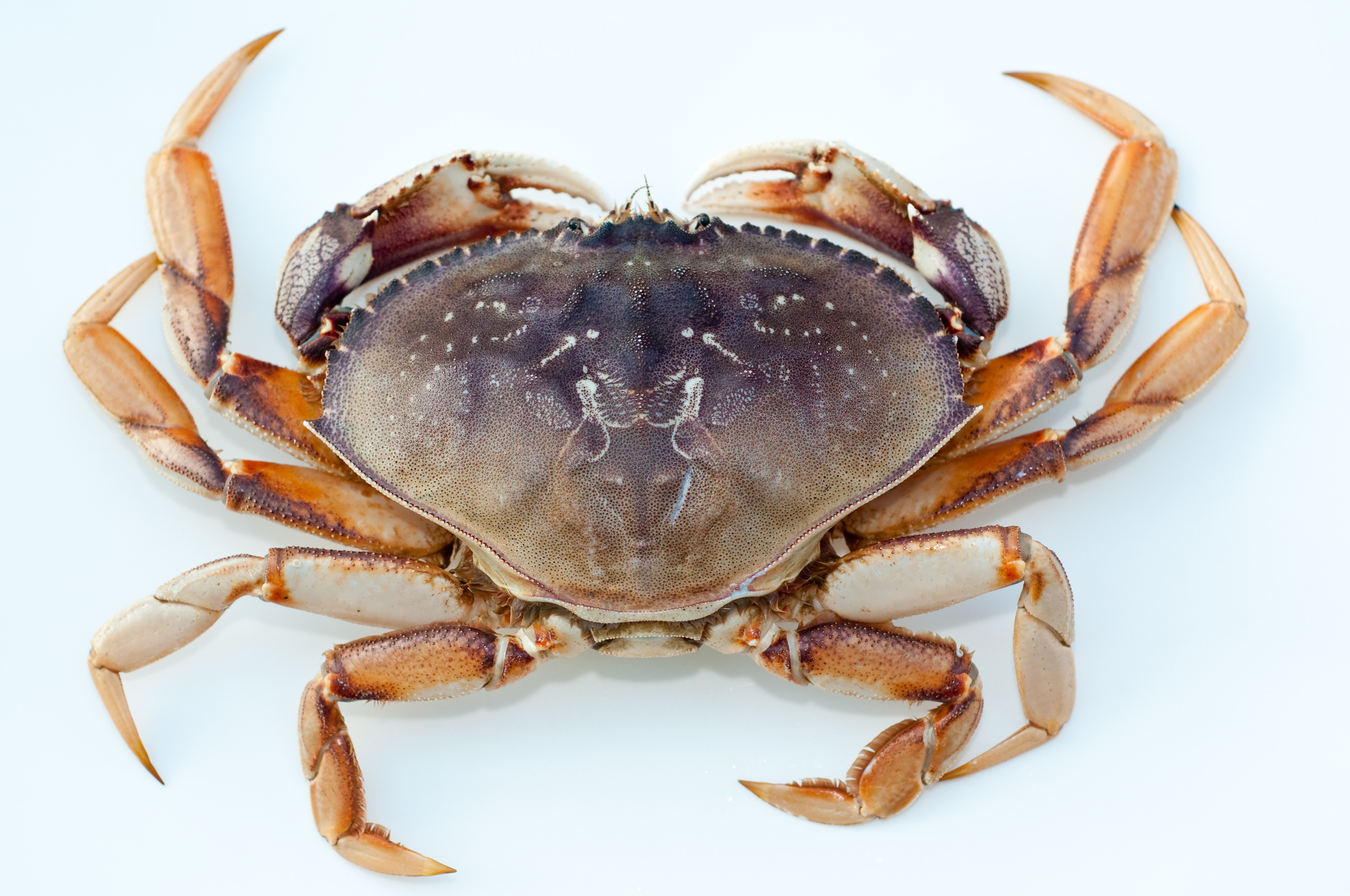
Photo by Kelvin Yue/iStock / Getty Images

Photo by Kelvin Yue/iStock / Getty Images

En anden ting jeg lærte var at sæsonen for dungeness crabs starter sidst i november, lige omkring Thanksgiving. Denne krabbe er en gudespise. Jeg plejer at købe dem forkogte i Whole Foods Marked, hvor de gør dem klar til servering. Når jeg kommer hjem damper jeg dem, til de er rygende varm, og serverer dem med koldt smør, brød og en god tør hvidvin.

Men der er jo ikke meget ved at lave et indlæg med det, så jeg valgte at lave en krabbesuppe, lidt a la en hummersuppe, bare knap så tyk. Jeg har valgt at bruge californsk olivenolie, Dungeness crabs, Organic Straus Heavy Whipping Cream (fløde) og en pinot grigio fra vores lokale vingård Picchetti

Til 6 personer som forret.

Ingredientser:

  • 4 Dungeness krabber (Jeg brugte 3 hele krabber og skallerne fra 1)

  • 3 spsk olivenolie

  • 3 fed hvidløg, hakket

  • 2 gulerødder, hakket

  • 2 stilke blegselleri

  • 1 fennikel, hakket

  • 3 kviste frisk estragon

  • 3 spsk konc. tomatpure

  • 50 ml cognac

  • ½ flaske tør hvidvin

  • 500 ml fiske boullion, eller vand og en boullionterning

  • 300-450 ml piskefløde

  • friskpresset citronsaft , efter smag

  • cayennepeber, efter smag

  • salt, efter smag

Fremgsangsmåde:

Fjern kløerne og kødet fra krabberne, og sæt det i køleskabet indtil lige før serveringen.

Varm olien godt op i en stor gryde. Kom krabbeskallerne i og steg dem ved høj varme i 3-4 minutter. Tilsæt gulerødder, selleri, tomatpure, hvidløg, porre, fennikel og estragon og forsæt med at sautere i endnu 10 minutter. Tilsæt cognacen og antænd den. (Jeg gør dette udendørs, da jeg ikke ønsker at have brand i køkkenet.) Når flammerne er dødet ned tilsættes hvidsvin og fiskeboullion og evt lidt vand, så det dækker krabberne. Lad suppen simre i 25 minutter, sluk for varmen og lad den trække i yderligere 10 minutter, før suppen sies. Jeg sier suppen af 2 gange. Først igennem en pastasigte og derefter igennem en mere finmasket sigte.

Smag på suppen. Hvis du ønsker en mere koncentreret smag, så kog suppen ind. Husk at suppen stadig skal have en del fløde, så det skal være en kraftig suppe.

I mellemtiden koges fløden ind til det halve. Tilsæt fløden til suppen og smag den til med salt, cognac, cayenne og citroinsaft.

Server suppen i opvarmede tallerkener henover en krabbeklo og lidt krabbekød. (jeg damper kløerne og kødet i et par minutter før serveringen).

Velbekomme!

The English version: 

Dungeness Crab Soup

Serves 6 as appetizer.

Ingredients:

  • 4 Dungeness crabs (I used 3 and shells from 1, all pre-cooked)

  • 3 tablespoons extra virgin olive oil

  • 3 garlic cloves, chopped

  • 2 carrots, chopped

  • 2 stalks celery, chopped

  • 1 fennel, bulb only, chopped

  • 3 sprigs fresh tarragon

  • 3 tablespoons tomato paste

  • 50 ml cognac

  • ½ bottle dry white wine

  • 500 ml fish stock or water and 1 bouillon cube

  • 300-450 ml heavy whipping cream

  • freshly squeezed lemon juice, to taste

  • cayenne, to taste

  • salt, to taste

Directions:

Remove the claws from the crabs and remove the crab meat from the shells. Refrigerate claws and meat, until serving.

Heat the oil in a large stockpot. Put the shells in the hot oil and brake them with a wooden spoon. Sauté the crab pieces for 3 to 4 minutes. Add the carrot, celery, tomato paste, garlic, leeks, fennel and tarragon and continue to sauté for another 10 minutes. Pour in the cognac and  ignite it. (I do this outside, to prevent a fire in the kitchen.) When the flames have subsided, pour in the white wine and enough fish stock or water to cover. Boil the soup for 25 minutes, remove from heat, let sit to rest for 10 minutes before straining the soup. I strained the soup in two steps. First straining through a colander, removing the large pieces, and then straining through a fine-meshed strainer. Taste the soup. If you want a more concentrated soup, reduce the soup, by simmering it, until you have the desired taste. Remember the soup will be diluted by the cream, so you need a strong base soup.

Meanwhile boil the cream until it has been reduced by half. Add the reduced cream to the base soup. Season the soup with salt, cognac, cayenne and lemon juice. 

Serve the soup in heated bowls over some crab meat and a claw. (Heat the meat and claw by steaming it for a few minutes.)

Enjoy!


St. Lucia Buns

Bread, Brunch, Christmas, HolidayTove Balle-PedersenComment
St. Lucia buns

St. Lucia buns

December 13th is Saint Lucia day.

St. Lucia buns aka lussekatter aka lucia breads, is a classic Swedish bun. Served on St. Lucia Day, december 13. in celebration of the light coming back. Young girls dressed in a white dress and a red sash (as the symbol of martyrdom) carrying a candle in their hands. One girl (the Lucia bride) wears a crown or wreath of candles on her head, all of them singing the Lucia song.

These St. Lucia buns are light, sweet with a nice saffron taste. I have to make these again soon. These buns reminds me of my moms version of birthday buns, a recipe lost forever.

Makes 24 lussekatter.

Ingredients:

  • 300 g (1¼ cup) milk 
  • 25 g live yeast or 2 teaspoons dry yeast
  • 100 g (½ cup) sugar
  • 1 teaspoon saffron
  • 1 teaspoon salt
  • 100 g butter, room temperature
  • 500 g  (5¼ cups) all-purpose flour
  • 1 egg + some for egg wash

Directions:

Put the saffron in a mortar and pestles with about a tablespoon of sugar, and pulverize the saffron-sugar.  In a saucepan heat the milk, saffron-sugar together until  the sugar dissolves and the milk warm to the touch, but not hot. 

Disolve the yeast in the warm milk, and add the rest of the milk. 

Add  the milk-mixture to the bowl of a stand-up mixer and mix in butter, egg, sugar, salt and most of the flour. Save some flour for the shaping of the Lucia buns.

Knead the dough for about 5 minutes. Cover the bowl and let the dough rise for about 40 minutes until almost doubled  in size.

Pour the dough onto a flour dusted workspace and divide into 24 small balls. Roll the balls out into snakes, about 14 inches long. Then curl the ends in opposite directions, forming an "S" with spirals at each end. Place the buns on a parchment paper lined baking sheet and repeat. Cover the buns and place in a warm spot to rise until the dough shapes double in size, about 30 minutes.

Preheat oven to 440°F (225°C). Brush the buns with some egg wash (beaten egg). Place raisins in the centers of the "S" spirals. Bake the Lucia buns  for about 8 to 10 minutes, until the buns are light golden brown.  Remove from oven and let cool covered by a kitchen towel for 5 minutes before eating.

Serve the buns warm with cold butter.

Enjoy!


Ebelskiver with Pear and Blue Cheese

Brunch, Christmas, Holiday, SnacksTove Balle-PedersenComment
Ebelskiver with Pear and Blue Cheese

Ebelskiver with Pear and Blue Cheese

Today is the first day in Advent, meaning the first of four Sundays before Christmas. In my house we start the christmas decorating on December 1st, or the 1st of Advent, which ever comes first. I might sneak in some christmas things earlier, but who is to judge me ;) On the 4 Sundays before christmas we gather with frinds and family to eat ebelskiver/æbleskiver and drink mulled wine/gløgg. This year I wanted to change it a bit with some savory ebelskiver filled with pear and blue cheese. And they are really good as a hors d’Oeuvre or snack with a glass of good red wine.

Makes about 15 ebelskiver.

Ingredients:

Ebleskiver:

  • 125 g all-purpose flour
  • 65 g butter (salted and melted)
  • 190 ml milk (1,6 cups)
  • ⅛ teaspoon salt
  • 2 eggs
  • 2 teaspoons baking powder

Filling:

  • 1 pear
  • blue cheese
  • 5 pecans

Directions:

Separate the egg yolks from the whites. Whisk whites with a mixer until stiff peaks form. Set aside. Mix milk with flour and baking powder till there's no lumps. Add the melted butter, egg yolks and salt. Let the batter rest for about 5 minutes. Gently fold in the egg whites, do not over mix the batter, but you don't want spots of egg whites in the batter. Heat the ebelskive pan. Fill the holes about ¾. As soon as the batter starts to bubble around the edge, turn* the ebelskiver halfway. Place a pea-sized piece of cheese and a few dices of pear + a sprinkle of chopped pecans into the batter, so it disappears. Add a little bit more batter to the ebelskiver. Turn the ebelskiver all the way, so you end up with a perfect ball. Continue cooking for a few minutes, turning the ball to keep it from burning. * I use a knitting needle to turn the ebelskiver, but you can also use a fork. Serve the ebelskiver hot too warm with a drizzle of honey and a nice glass of wine.

Enjoy!

Bagels

Bread, Breakfast, BrunchTove Balle-Pedersen1 Comment
Bagels

Bagels

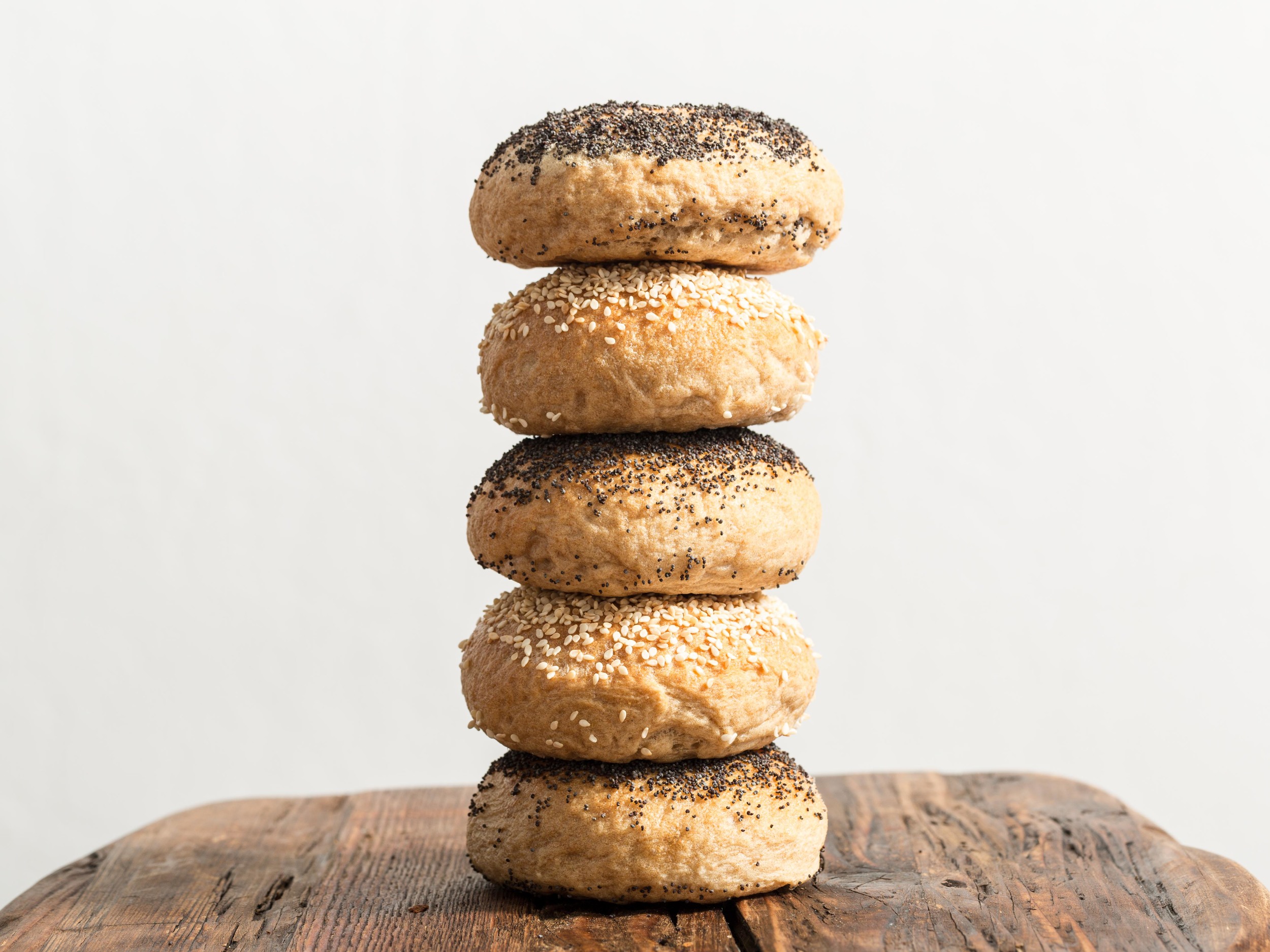
Living in the US, I had to try making bagels. I have been somewhat reluctant because you need to boil bagels before baking. But after makings these, I will definitely  be making bagels again. It was well worth the effort. 

I have to thank Bettina from the Danish baking group on Facebook, she inspired my to give bagels a try.

Ingredients:

  • 400 ml warm water + 50 ml
  • 50 g live yeast, or 4 teaspoons dry yeast
  • 20 g salt
  • 1 tablespoon honey
  • 200 g whole wheat flour
  • 500 g all-purpose flour or bread flour
  • 2 tablespoon maple syrup, for the boiling water
  • 1 beaten egg white + a splash water, for the glaze
  • 2 tablespoons cornmeal, for the pans

Toppings:

  • sesame seeds
  • poppy seeds

Directions:

In the bowl of a stand mixer, combine 400 ml warm water and yeast. If using dry yeast add a sprinkle of sugar  and leave to sit for about 10 minutes until the yeast begins to blossom.

Add honey and both flours and mix it for about 3 minutes on low speed. Let the dough rest for about 5 minutes so the flours get hydrated. Add the salt and the rest of the water and knead dough on low for about 8 minutes. Cover the mixer bowl with plastic wrap and let the dough to rise for 1 hour.

Turn dough onto a lightly floured work surface and punch down. With a bench scraper or knife divide the dough into 12 equal pieces, about 100 g a piece. Shape each piece into a ball, and allow them to rest for 3-4 minutes.

Spray a piece of parchment paper with oil, and sprinkle cornmeal all over it. Preheat the oven to 450℉ (230℃).

Poke a hole through the center of each ball to create a bagel shape. Holding the dough with both index fingers in the hole, rotate the dough with your hands, gradually stretching it to create a hole about 2 inches in diameter. Place the bagels on the cornmeal, and let them rise for about 10 minutes covered with a clean kitchen towel.

Bring water and maple syrup to a low boil. Line 2 baking sheets with parchment paper, and set a side.

Gently lift bagels, one at a time, and lower into the simmering water. Do not do more than 2 or 3 at a time, so you don't lower the water temperature to much. Cook the bagels for 60 seconds on each side, give or take, then flip them over in the water using a slotted spoon, and cook for another 60 seconds. Lift bagels out with the slotted spoon, and place on the baking sheets. Repeat until all the bagels are boiled.

Brush the bagels with the foam from beaten egg wash, and sprinkle with the toppings.

Bake the bagels for 20-30 minutes until golden brown.

Let the bagels cool completely on a wire rack. 

Serve Bagels with your favorite cheese or use the bagels for a sandwich.

Enjoy!

This post has been submitted to YeastSpotting

Baked Spinach Omelette Roulade with Goat Cheese

Brunch, Dinner, LunchTove Balle-PedersenComment
Baked Spinach Omelette Roulade with Goat Cheese

Baked Spinach Omelette Roulade with Goat Cheese

In my family we really like these baked omelettes, or “madpandekager" as we call them in danish. They are easy to make and you can fill them with whatever you like. I had been craving goat cheese for a few days, so I had to try a simple filling for the omelette, but I knew I needed to add some meat to the mix, to satisfy my husbands tastebuds. The crispy prosciutto did the trick, and it added some texture to the meal as well. 

Next time, I'll add some more vegetables to the roulade. 

Serves 3-4

Ingredients:

Omelette:

  • 4 eggs
  • 125 g all-purpose flour
  • 400 g non-fat milk
  • 1 teaspoon salt
  • 360 g fresh baby spinach

Filling:

  • 100 g Philadelphia light plain or with onions and chives
  • 1 handful kalamati olives, pitted
  • 3 tablespoons sun dried tomatoes, julienned
  • 1 red onion in balsamic
  • 150 g goat cheese
  • 8-10 thin slices prosciutto

Direction:

Preheat oven to 400℉ (200℃).

In a very large pot heat a little olive oil sauté the spinach. Cook it for about 2 minutes, until all the spinach is wilted. Let the spinach cool for at few minutes.

Whisk together the rest of the omelet ingredients. Blend the batter with the spinach until smooth and green.

Line a large jelly roll pan with parchment paper, leaving an over hang of about 1 inch at each end. Grease the parchment paper. (I learned the hard way, that you can't use multiple sheets of parchment paper. You'll just end up with the parchment paper baked into the omelette.) 

Pour in egg mixture. Gently place it in the oven and bake for about 30 minutes. Remove, allow to cool for a few minutes. Flip the omelette onto another parchment paper, so it's upside down.

Using the same jelly roll pan and parchment paper, place the prosciutto on the pan and put them into the oven for 10-12 minutes to crisp up.

Dollop on the cream cheese and spread it evenly. Sprinkle on the filling, leaving about an inch with no filling. Place the prosciutto on top. Gently roll up length ways, pulling back the parchment paper as you go.

Slice in to 6-8 slices. Serve warm or room temperature, with a simple salad on the side. 

The omelette is great for lunch or dinner, just serve a simple salad on the side. It is very easy to change it up. It works great with fresh spinach, red pepper and smoked salmon. Or with taco-seasoned ground beef, jalapeño, tomato and corn. But why not serv it with yesterdays leftovers?

Enjoy!