Sweet • Sour • Savory

Food blog on scandinavian style food done right.

Holiday

Mrs. Hobbs's Italian Rosemary Cookies

Cake, Christmas, Cookies, HolidayTove Balle-Pedersen2 Comments
Italian Rosemary Cookies

Italian Rosemary Cookies

These cookies are to die for!!!

How my friend and the whole world kept this recipe away from me, for so many years, it’s beyond my understanding.

If you only are baking one cookie this year, make it this one!

Makes 60-70.

Ingredients:

  • 250 g butter, salted and room temperature

  • 400 g sugar

  • 2 eggs

  • 30 g raw pistachios, finely chopped

  • 10 g (3 tablespoons) fresh rosemary leaves, finely chopped

  • 450 g all-purpose flour

  • ½ teaspoon salt

  • 3 teaspoons baking powder

  • 1 orange, the zest

Directions:

Cream butter and sugar until light and fluffy. Add 1 egg at a time, making sure it’s fully incorporated, before adding the next. Mix in orange zest, rosemary, and pistachios. Sift flour, salt and baking powder and incorporate it in the dough.

Divide the dough into 3 pieces. Roll each part into a log (2 inch in diameter), wrap in Glad wrap, shape the log into a square, by pressing the log onto the kitchen counter. Refrigerate overnight. Try to make a smooth surface to get an even look on the finished cookies. Well, the dough were very soft, so I didn’t get the smooth surface on my logs. 🙃

Cut the logs into thin cookies and put them on a baking sheet lined with parchment paper. Spacing about 1-inch apart. Bake until golden around the edges, about 5-7 minutes at 350°F. Cool cookies on the pan on wire racks. Store in an airtight container at room temperature for up to 2 weeks.

Enjoy!

Dansk Version:

Italienske Rosmarinsmåkager

Ingredienser:

  • 250 g smør, saltet og stuetemperatur

  • 400 g sukker

  • 2 æg

  • 30 g usaltede pistacienødder, finthakket

  • 10 g (3 spsk) frisk rosmarin, finthakket

  • 450 g hvedemel

  • ½ tsk salt

  • 3 tsk bagepulver

  • 1 appelsin, skallen af

Fremgangsmåde:

Pisk sukker og smør hvidt, let og luftigt,. Tilsæt et æg af gangen, så det bliver mikset godt ind inden det næste æg tilsættes. Bland rosmarin, appelsinskal, salt og pistacienødder i. Sigt mel og bagepulveret ned i dejen, og rør det i.

Del dejen i 3 dele, og rul hver del til en stang med ca 5 cm diameter. Kom film (vita Wrap) omkring hver stang, og pres rullerne firkantet, ved at presse stængerne ned mod køkkenbordet. Prøv at gøre overfladen så glat som muligt. Læg nu dejstængerne i køleskabet natten over.

Når du er klar til at bage, opvarm ovnen til 175℃. Skær stængerne i tynde skiver og læg dem på en bageplade med bagepapir, med ca 2-3 cm afstand.

Bag småkagerne indtil de er gyldne i kanterne, ca 5-7 minutter. Afkøl småkagerne på bagepapiret på en bagerist. Opbevar småkagerne i en lufttæt beholder.

Enjoy!
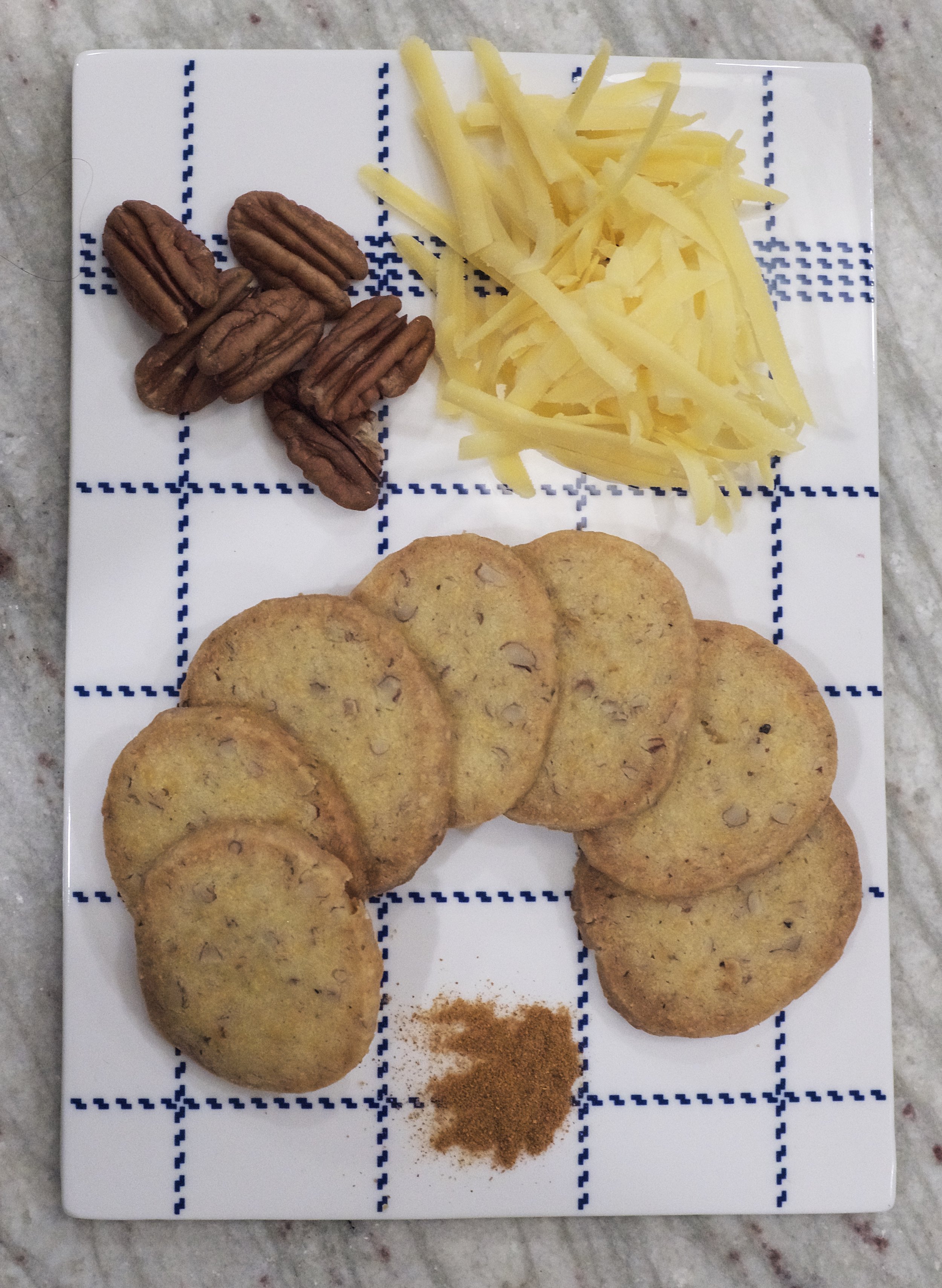
Mrs. Child's Cheese Crackers

Appetizer, Brunch, cheese, Holiday, SnacksTove Balle-PedersenComment
Southern Cheese Crackers

Southern Cheese Crackers

It’s no secret I LOVE cheese. So when a friend of mine told me about these cheese cracker, it was a no-brainer, I had to make them. The most surprising was, that it took me almost a month to do so.
These crackers a very addictive, and pair well with a cold beer or a nice glass of wine. If you’re not into the spiciness, then drop the cayenne.

Recipe by Robyn Stone.

Makes 40-60 crackers.

Ingredients:

  • 200 g (2 cups) freshly shredded sharp cheddar cheese

  • 112 g (1 stick) salted butter, softened

  • 1 teaspoon salt

  • ½ teaspoon cayenne pepper

  • ¼ teaspoon freshly ground black pepper

  • ⅛ teaspoon garlic powder

  • 60 g (½ cup) pecans, finely chopped

  • 145 g (1½ cups) all-purpose flour

Directions:

Cream the butter with the grated cheese for about 3 minutes. Mix in the salt, cayenne, black pepper, and garlic powder. Add the flour a little at a time, stirring after each addition until the ingredients are well combined and a dough forms. If the dough seems a little dry, ad 1 or 2 tablespoons of water.

Shape the dough into two 1-inch (2½ cm) diameter logs. Wrap in parchment or plastic wrap. Twist the ends and refrigerate 30 minutes or overnight.

Preheat oven to 375℉ (190℃). Line 2-3 baking sheets with parchment paper.

Cut the logs into ⅛-inch (⅓ cm) thick slices and place ¼-inch (1 cm) apart on the prepared sheet.

Bake until light golden brown, about 12-15 minutes. Transfer to a cooling rack to cool completely. The crackers will keep in an airtight container for up to 1 week. This is theoretical because they evaporate faster in my house.

I can recommend making some extra dough, and freeze it, for an easy snack for when you have guests.

Enjoy!

Beetroot Gravad Lax

Appetizer, Christmas, Fish & seafood, HolidayTove Balle-PedersenComment
DSCF1666_PM.jpg

Thanksgiving and December really sneaked up un me this year. As many others in California, we were living in unhealthy air due to the big wild fires. We tried to escape to the Sierras, and this threw my schedule way off. But now, over halfway to Christmas, I’am getting back into the game.
We are going to the annual Danish Christmas lunch, and I alway make gravlax. This year I decided to make 2 different versions, the regular and a pretty red beetroot and gin version.

The pretty pink gravlax is delicious too. I serve it with a dill and creme fraiche sauce.

Ingredients:

  • 800 g side of salmon, skin on, scaled, pin-boned, from sustainable sources

Beet cure:

  • 200 g raw beets (2 beets)

  • 2 lemons, the zest of

  • 100 g coarse sea salt 

  • 50 g sugar 

  • 50 ml gin (I used Hendricks)

Herb cure:

  • 1 big bunch of fresh dill, finely chopped

  • 6 sprigs, tarragon, the leaves, finely chopped

  • 50 g fresh grated horseradish 

  • 50 ml gin (I used Hendricks)

Directions:

In a food processor or mini chopper, blitz together the beets , gin, and lemon zest until they become a smooth paste. Transfer the beet mixture to a small bowl and mix in the rock salt, and sugar.

Rub a little mixture on to the salmon skin, then place the salmon, skin side down, in a large zip lock bag in a dish or baking tray. Pat the remaining mixture all over it so that the salmon is completely covered. Remove as much of the air from the zip lock bag as possible. Pace a little cutting board on top of the salmon, and place some weight on top to have an even pressure on it. Place in the fridge for 24 hours.

After 24 hours, gently unwrap the salmon and remove the beet mixture. Gently splash the salmon with a bit of water to rinse off any remaining cure and rinse the dish too.

Mix together the herb cure ingredients in a small bowl, place the salmon (skin side down) in a new zip lock bag in the dish. Cover the salmon evenly with the herb cure. Remove air and put the weight on back onto the salmon. Refrigerate for another 24 hours.

The next day, your cured salmon will be ready to enjoy. The herb mixture does not need to be rinsed off- just thinly slice the salmon and serve it as an open faced sandwich, with a creme fraiche (or sour cream) with dill.

Enjoy!

Amaretto Eton Mess

Cake, Desserts, HolidayTove Balle-Pedersen2 Comments
Amaretto Eton Mess

Amaretto Eton Mess

This dessert is a mild twist on an English classic, originating from the Eton College's annual cricket game against the pupils of Harrow School. But this is a pavlova dressing up as a layer cake. 

A great easy to make dessert, perfect for the summer parties.

Serves 6-8.

Ingredients:

Meringue:

  • 6 egg whites

  • 300 g sugar

  • 1½ teaspoon lemon juice

  • 50-75 g almond slivers

Filling:

  • 500 ml heavy whipping cream

  • 500 g fresh strawberries, rinsed and sliced.

  • 50 ml Ameretto (Italian almond liqueur)

  • 1 tablespoon confectionary (powdered) sugar

Directions:

Preheat the oven to 250*F (120℃).

Draw 3 x 9-inch (23 cm) circles about 2-inch (5 cm) apart on a parchment paper, and turn the parchment paper upside down, so you don't get any pencil on the meringues.

In the bowl for the stand mixer, beat egg whites until stiff peaks. Add the sugar gradually, a couple tablespoons at a time, while still beating the egg whites. The egg whites/meringue will become thick and glossy. Gently fold in lemon juice.

Spoon the meringue inside the drawn circles on the parchment paper. Spread the meringue working from the center towards the edge. Sprinkle with the almond slivers

Bake the meringues for about 60 minutes. Then turn off the oven, and leave the meringues in the oven for another 30-45 minutes, until the oven is cooled. I became a little impatient, so I pulled the meringues out before they were cooled completely, and that is why the meringue traced a bit.

Fold in half the confectionary sugar in the sliced strawberries, set aside.

Whip the cream until medium stiff peaks. Gently fold in some confectionary sugar and amaretto. 

Place the least pretty meringue on a cake stand, and spread ⅓ of the cream topping it with some strawberries. Repeat layering the rest of the meringues, cream, and fruit. Finishing the top layer with a few whole strawberries.

Enjoy!

Romsnegle - Rum Rolls

Bread, Breakfast, Brunch, Cake, Holiday, techniqueTove Balle-Pedersen1 Comment
Romsnegle - Rum Rolls

Romsnegle - Rum Rolls

Romsnegle is a stable at a Danish baker's shop, much like the regular danish (spandauer). This is much like a cinnamon roll made with puff pastry dough and with another filling and icing. Same, - but totally different. This sweet filling pairs so well with the (imitation) rum icing. Ohh so yummy.

Making these rolls with puff pastry makes for a flakier and softer roll. Of cause this is a time consuming bake. But well worth the effort.

The Danish pastry is a laminated yeast dough much like the French croissant. There are many ways to make this lamination. The amount of layers are different from country to country and from baker to baker. You get the flaky layers by folding sheets of dough with butter. 

One of the more important things in puff pastry is the butter. You want to use a european style butter. The European butter contains less liquid and more milk fats than American butter. Most people opt for unsalted butter, but I always use salted butter in my baking.

There are different kinds of folding/turning when it comes to pastry and croissant dough:

Letter fold or Single turn: Dough folded in thirds, like you would do a letter going into an envelope. (I did this for this recipe.)

1. Turn: makes 3 layers of butter

2. Turn: makes 9 layers of butter

3. Turn: makes 27 layers of butter.

Book fold or double turn: Dough folded to the middle and folded again on the middle like a book. This makes 4 layers per fold or turn as they are called.

1. Turn: makes 4 layers of butter

2. Turn: makes 16 layers of butter

3. Turn: makes 64 layers of butter

Some people claim that any more layers than 3 turns using a letter fold, will make the dough like a brioche instead of providing the flaky layers. The 3 turns makes 27 layers. You can mix the folding methods to get the amount of layer you want.


Makes 20.

Ingredients:

Dough:

  • 375 g all-purpose flour

  • 200 ml milk

  • 25 g live yeast or 2 teaspoons dry yeast

  • 45 g sugar

  • 50 g butter, salted and soft

  • 1 egg

Butter block:

  • 350 g butter, cold (use a European style butter, it contains less water, than the American butter)

  • all-purpose flour for dusting

Remonce:

  • 100 g butter, salted and soft

  • 100 g sugar

  • 70 g marzipan

  • 1 teaspoon vanilla bean paste

  • 1 tablespoon all-purpose flour

Icing:

  • 1 egg white (pasteurized)

  • Confectionery (powdered) sugar

  • 1-2 teaspoon imitation rum

multicolored sprinkles

Directions:

Dough:

Heat the milk to lukewarm (99℉/37℃). Dissolve the yeast in the warm milk. Add the sugar. If using dry yeast, let the yeast wake up for about 5-10 minutes, until creating a foam on top. Incorporate the egg.

Mix in half of the flour, forming a sticky dough. Mix in the softened butter. Finally mix in the rest of the flour and knead the dough until you have at shiny, slightly sticky and elastic dough, for about 3-5 minutes.

Place the dough on a very lightly floured surface. Using a bench scraper and one hand, work the dough into a round. The tension will build as the dough achieves to the surface as you rotate it.

Place the dough back in the bowl and let it rise until doubled in size, for about 60 minutes.

Butter block: 

Place the cold butter on a well floured surface. With your palms press the butter a little flat. Using a rolling pin pound on the butter to flatten it. Fold the butter into its self, and keep pounding and folding until the butter has the same consistency as the dough. You want to end up with a 15x15 cm / 6x6 inch square of soft but still cold butter. If the butter is too warm or too hard, it will be hard to roll it out in the dough, and it might make holes in the dough, instead of the lamination.

Laminating

Laminating

Laminating:

Place dough  on a lightly floured surface, roll 4 wings out from the center, leaving a center (15x15 cm / 6x6 inch), the same size as the butter block.

Place the butter block over the center, fold the wings over the butter, making sure not getting too much flour in between the layers. Turn the dough over, so the seams are facing down.

Roll the dough to a rectangle, 3 times as long as the hight. Keep it lightly floured so the dough do not stick to the surface. Make sure to roll the dough with straight edges. This will ease the folding.

Making a fold.

Making a fold.

1. Turn: Fold the rectangle in thirds, like a letter. Now you have 3 layers of butter. Place the dough in the freezer for about 20 minutes to cool the butter again.

Repeat this 2 times, making 3 turns and ending up with 27 layers of butter. Let the dough rest on the kitchen counter for 10-20 minutes. (If your kitchen is warm, do the resting in the refrigerator.)

Now the dough is ready to use as a puff pastry for sweet or savory dishes.

If you want to make sweet pastries, you want to make the 3. Turn on a surface sprinkled with about 100 g granulated sugar, and sprinkle another 100 g granulated sugar on top. This will make the dough sweeter and more crispy.

Remonce: 

Mix the all the ingredients so you end up with a soft fluffy mixture. You want to have a soft mixture, so you won't rip the dough, while spreading the remonce. The added flour will prevent the filling to ooze out of the rolls while baking.

Making the rolls.

Making the rolls.

Making the rolls:

Turn the dough out onto a lightly floured surface, and roll it to a large rectangle (16x16 inches/40x40 cm).

Spread the filling in a thin layer onto the dough, leaving a thin edge closest to your self, without filling.

Line 2-3 bakings sheets with parchment paper.

Roll the dough into a large log. Cut the log into 20 slices. When you place the slices on the prepared baking sheets, tuck the lose ends under the roll, and give the roll a little press.  Leave a good spacing between them, so they can spread out without "growing" together. Cover the rolls with a tea towel to rise for about 20 minutes.

Preheat the oven to 355℉ (180℃).

Bake the rolls for 14-16 minutes until deep golden brown.

Let the rolls cool completely, before icing.

Enjoy!

Tips:

The unbaked pastry can be frozen just, after shaping, individually, and can be baked straight out of the freezer, just add about 5 more minutes to the baking time.