Sweet • Sour • Savory

Food blog on scandinavian style food done right.

Poultry

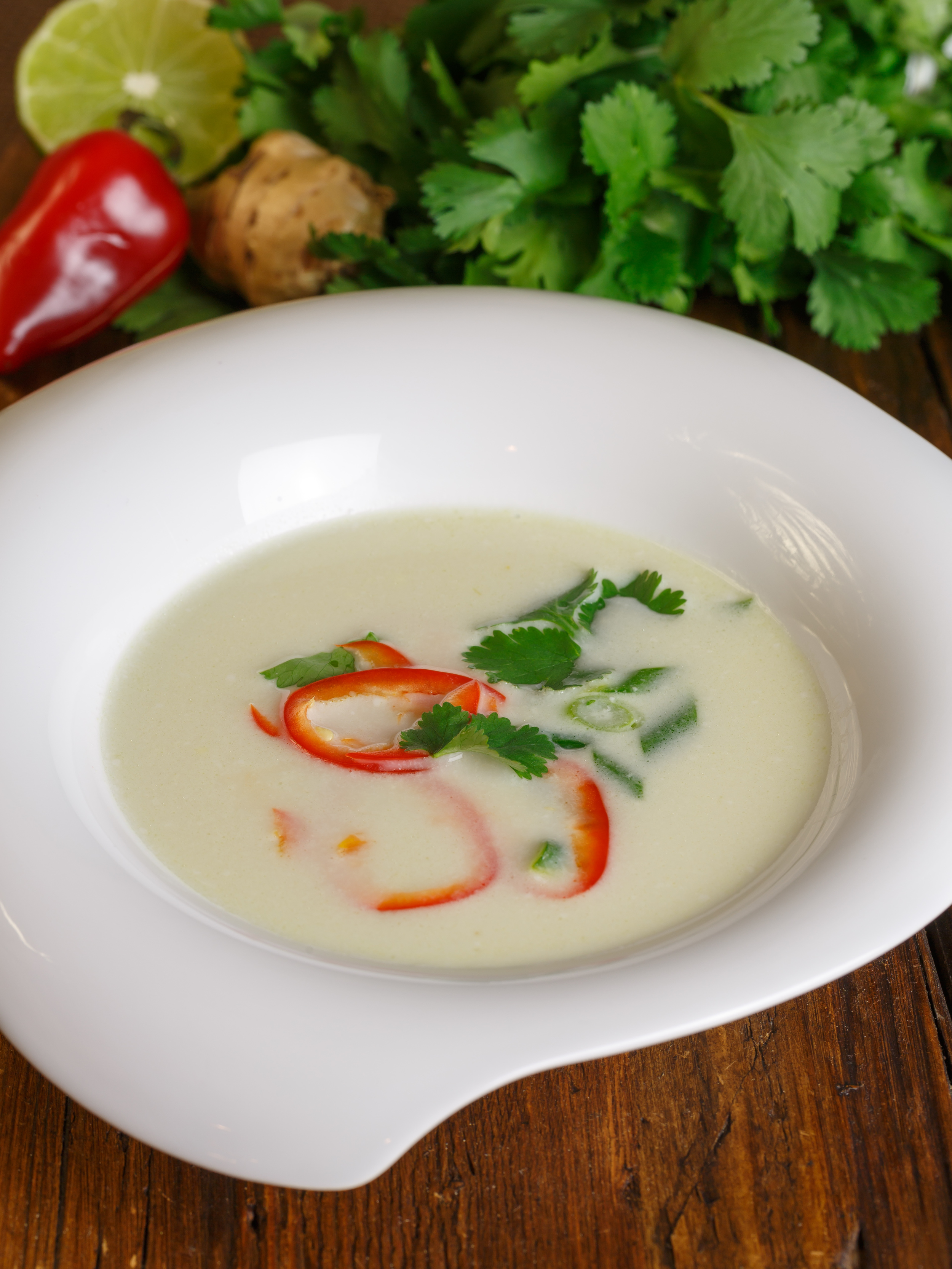
Tom Ka Gai - Coconut Chicken Soup my way

Dinner, Poultry, SoupTove Balle-Pedersen2 Comments
Tom Ka Gai - Coconut Chicken Soup my way

Tom Ka Gai - Coconut Chicken Soup my way

We love soups in my house, we try to have soups at least every other week. We had this soup as a "skrub af suppe" directly translated to "go away soup or go home soup." It's kinda midnight snack, a nice way to end a party, getting some salt into people there has been drinking all your wine a liquor. ;)

This is my version of Tom Ka Gai soup, it not the original recipe, but made to my taste.

Serves 2-3.

Ingredients:

  • 1 pound (450 g)chicken breast tenders
  • 2 teaspoons chicken paste
  • 850 ml water
  • 1 inch minced ginger
  • 2 cloves garlic
  • 2 lemongrass
  • 1 lime the juice of
  • 3 teaspoons fish sauce
  • 1.5 can coconut milk

Topping:

  • 5 scallions/spring onions
  • 1 chilli, thinly sliced
  • a few sprigs fresh cilantro


Directions:

Cut chicken tenders into bite size pieces. 

Blend ginger, garlic and lemongrass with a splash of the coconut milk, till it has the texture of a thick paste. If you like the soup spicy, add some chilli  to the blender. Bring water, chicken paste, ginger paste and chicken to a boil while stirring. Let the soup simmer for about 5 minutes.

Add the coconut milk, fish sauce and bring soup to a low simmer. Season the soup with lime juice and salt. 

Serve the soup hot with scallions, cilantro and chilli as topping.

Enjoy!

Chicken Braised in White Wine (Coq a Vin Blanc)

Dinner, Poultry, Simmer Food, food, recipeTove Balle-PedersenComment
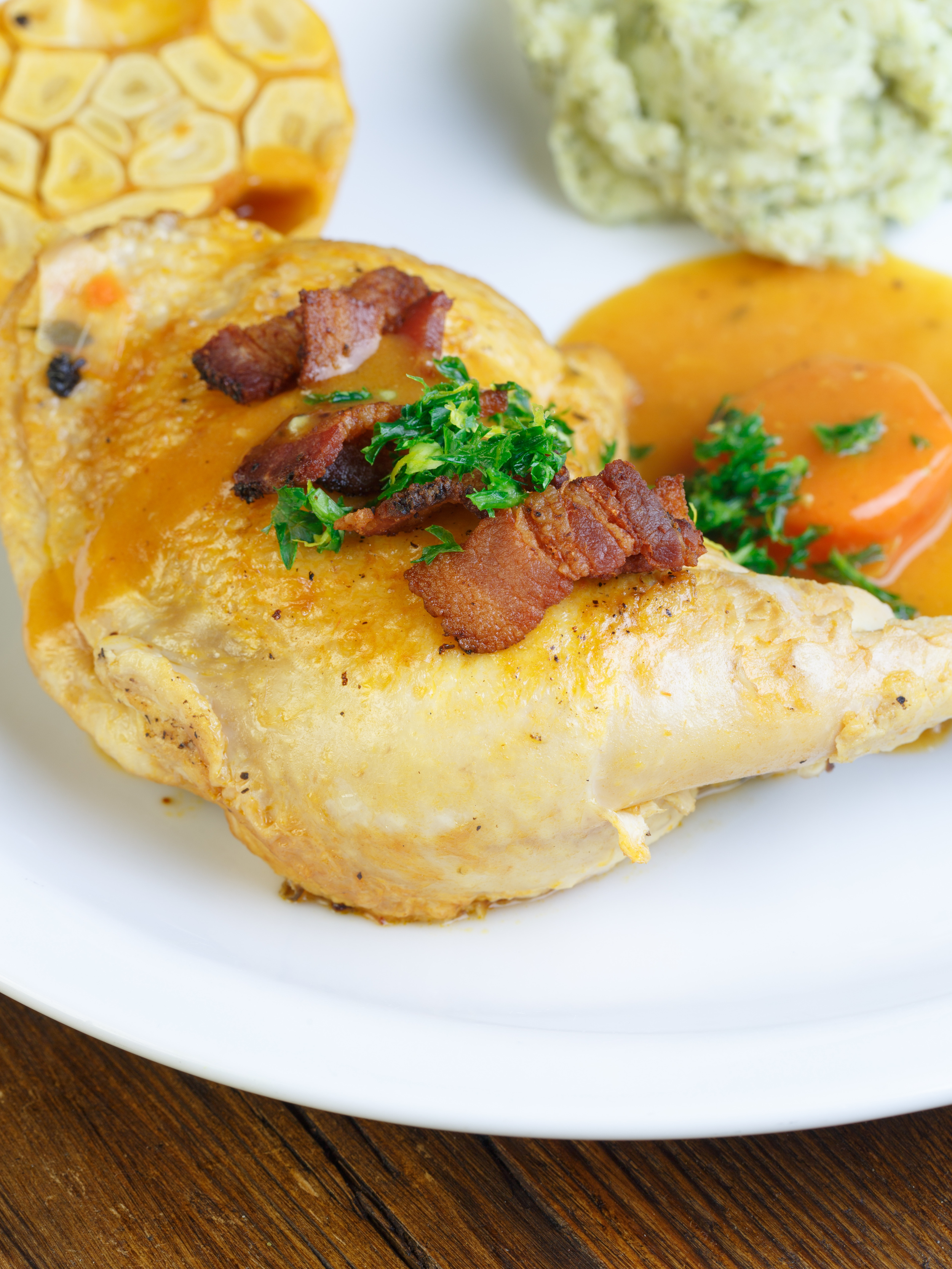
Chicken Braised in White Wine (Coq a Vin Blanc)

Chicken Braised in White Wine (Coq a Vin Blanc)

I really love the regular coq au vin. The first dinner i ever made for my husband  when I first met him, was coq au vin. Little did I know, that he didn't like wine. Well I didn't scare him off completely and now I learned him to drink wine. I must be a bad influence...

Normally I'll make coq au vin with red wine, but at a cooking class at Sur La Table we learned to make it with white wine, and it was so delicious, the perfect simmer food.

Ingredients:

  • 200 g thick-cut bacon, cut into cubes
  • canola oil, as needed
  • salt & freshly ground black pepper
  • 1 good sized chicken for roasting (4 to 5 pound), cut into 8 serving pieces 
  • 1 large onion, peeled and cut into 1-inch pieces 
  • 2 large carrots, peeled and cut into 1-inch pieces 
  • 2 large celery ribs, trimmed and cut into 1-inch pieces 
  • 1 leek, trimmed, white and light green parts only, cut into 1-inch pieces 
  • 3 tablespoon tomato paste
  • 1 head garlic, halved 
  • cup  (30 g) all-purpose flour
  • 1 bottle full-bodied dry white wine, such as white Burgundy.*
  • 2 teaspoons chicken paste
  • 500 ml water
  • 4 sprigs fresh thyme 
  • 1 bay leaf
  • 2 teaspoon cracked black peppercorns
  • 3 tablespoons fresh thyme leaves, for garnish

Gremolata:

  • handfull Italian parsley
  • 2-3 lemons, the zest of
  • 3 garlic cloves


Directions:

Preheat oven to 350 degrees and place a rack in the bottom third. 

Place bacon in a large Dutch oven and heat over medium heat. Cook bacon until crispy and fat has rendered, about 8 to 10 minutes. Transfer bacon to a paper towel-lined plate, leaving some of the fat in the Dutch oven. 

Season the chicken pieces generously on all sides with salt and pepper. Place chicken in the Dutch oven and sear to a deep brown on all sides, about 8 to 10 minutes, working in batches as needed. Transfer chicken to a rimmed baking sheet. 

Add onion, carrot, celery, and leek to Dutch oven and cook, stirring occasionally, until vegetables are browned, about 8 to 10 minutes. Add tomato paste and garlic and cook, stirring often, until tomato paste turns a deeper red, another 1 to 2 minutes. Sprinkle flour over vegetable mixture and cook, stirring to incorporate, about 1 to 2 minutes. Add wine to Dutch oven and, using a wooden spoon, scrape the bottom of the pan to release any browned bits. Cook until wine mixture begins to thicken, about 4 to 5 minutes. 

Return chicken to Dutch oven along with any juices from the baking sheet and add chicken base and enough water to barely cover the chicken. Add thyme, bay leaves and peppercorns, stirring to combine. Cover the Dutch oven and place in the preheated oven. Braise the chicken until fork-tender, about 50 to 60 minutes. 

Remove Dutch oven from oven and, using tongs, carefully transfer the chicken to a rimmed baking sheet. Cover loosely with foil to keep warm. 

Discard the thyme sprigs and the bay leave. Place dutch oven over high heat and cook braising liquid until reduced and thickened, about 10 to 12 minutes, skimming the surface for excess fat. Taste and season with salt and pepper as needed. 

Serve family style with gremolata, mashed potatoes or vegetables.

Serve immediately.


Gremolata:

Rinse the parsley, zest the lemons and peel the garlic cloves. Finely chop the ingredients together. I use the mini chopper that came with my Immersion Blender. 


* Don't use a oaked wine, since oakey wine can turn bitter when reduced.


Slow-roasted Duck

Christmas, Dinner, Poultry, HolidayTove Balle-PedersenComment
Slow-roasted Duck

Slow-roasted Duck

December 18. - I have to take a break from all the sweets. Who would like a piece of a roasted duck?

Duck is traditionally served at the christmas dinner in Denmark. Actually 75% of danes eat duck at christmas. Back in the days people ate goose, and it was roasted in the large ovens in the bakeries, because peoples own oven was too small. Slowly people gravitated towards the duck, because of its size and prize. Farmers wanted to get the good money from the geese they raised, and would eat the cheaper duck themselves.

A Danish-style roasted duck is filled with prunes and apple slices, to keep the duck breast moist. I like to add some slices of oranges and some christmasy spices for extra flavor.

The duck in the picture was a very young bird, maybe only about 5-7 weeks old. So it's a very small bird, with not to much meat on its bones. These ducks are OK if you are making Peking Duck, but is not the best for a danish-style duck. Normally I like an older bird, around 10-12 weeks old. These birds have much more meat. The small bird cost me about $22, and would serve 3 people, while the older one cost $36 and can serve about 6 people. I buy my ducks from Grimaudfarms.com in Stockton, California. I’ve have been very pleased with the birds I have gotten from that place.

This is my take on the danish-style roasted duck.

Ingredients:

  • 1 duck (7-8 pounds)
  • 2 oranges
  • 2 apples
  • 2 handful of pitted prunes
  • A handful salt and some pepper
  • 1 star anise
  • 3 whole allspice
  • 5 whole cloves
  • 1 stick of cinnamon

Directions:

Preheat the oven to 265℉ (130℃).

Chop the oranges and apples in the size of the prunes. Mix star anise, allspice, cloves and the broken cinnamon stick with apples, oranges and prunes. Have the salt in a clean cup.

Take neck and giblets out of the duck. Make sure that all feather sacks are out of the duck, you don't want a hard part of the feather in the crispy skin.

Pad the duck dry with some kitchen towel. Salt the duck inside, and fill it with the fruit mixture. Close the opening with a  trussing needle. 

Truss the duck by placing the duck on a tray with the legs towards you. Tuck the wing tips under the duck. Cut a piece of cooking twine about 3 feet (1 meter), and center it on top of the neck end of the breast. Lift the neck end of the duck and pull the twine down around the wings and under the duck, then bring the ends up over the breast, towards you, and knot the twine, pulling it tight to plump the breast. Bring the ends of the twine around the ends of the drumsticks and straight up. Tie as before to pull the drumsticks together and form a compact bird; tie again to secure knot."

Well, I did it my way, and tried my best to get the compact duck. Sometimes I just pull the wing onto the back of the duck, and use a cooking rubber band to tie the legs together.

Salt the duck with a lot of salt. 

Put the duck in the oven, breast side down, and cook it like this for 3-3½ hours. Have a pan under the duck, and put the giblets, neck and water in it. This water/drippings will be the base for the sauce. 

After 3½ hours turn the duck breast side up, and roast it for another 1½-2 hours until the temperature in the duck reaches 158℉ (70℃). If the skin isn't crispy, give the bird a few minutes under the boiler, be careful not to burn the duck.

Take the duck out and let it rest. Pour the drippings from the pan through a strainer into a saucepan. Skim the fat from the surface. I use a fat separator, which makes this process a breeze. Save the fat in the refrigerator or the freezer. Duck fat is a flavorful fat, and is perfect to roast potatoes in.

Add some cream, blue cheese and red currant jelly to the drippings and thicken the sauce, just like for the Danish pork roast.

Remove the twine and carve the duck, and serve with pickled red cabbage and Danish caramelized potatoes.


Poularde au Bayard - Chicken in White Wine

Poultry, DinnerTove Balle-PedersenComment
Poularde au Bayard

Poularde au Bayard

Poularde au Bayard was a dish my parents mad when they had people over. It's a dish where all the work is in the preparation. It's slow food at its best.

I think the recipe came from a pamphlet my mom got from the local butcher, but the details are lost in history. I remember that we all loved this chicken dish, and it was a treat when we had it. I removed most of the butter, because I don't need to have my meals dripping with butter. In my opinion there's no loss of flavor.

Ingredients: 

  • 1 large chicken
  • 3 carrots
  • 4 tomatoes
  • 4 onions
  • 2 bay leaves
  • 1 garlic clove
  • 24 whole cloves
  • 1 cup white wine
  • butter and olive oil for searing
  • ½ teaspoon tarragon
  • ½ teaspoon basil
  • ½ teaspoon paprika
  • ½ teaspoon rosemary
  • ½ teaspoon thyme
  • ½ teaspoon garlic powder or a garlic clove
  • salt & pepper


Onions with cloves

Onions with cloves

Directions: 

Peal the carrots and the onions and wash the tomatoes. Cut the carrots into 1 inch pieces. Press the cloves in the onions, 6-8 in each.

Clean and pad the chicken dry. Season the chicken with salt and pepper. Add butter and oil to a large pot. It should fit the chicken and all the vegetables. I use a 6.5 liter (6.8 QT) pot. Brown the chicken in the butter/oil. Get a good sear on it for flavor and color. Take the chicken out of the pot again.

Put the tomatoes, carrots and the onions in the bottom of the pot with all the spices. Add garlic, bay leaves and the wine and the chicken on top and put the lid on. Let it simmer for 45-60 until tender (170° F) 

Carefully take up the chicken and vegetables. Thicken the sauce with cornstarch in cold water, and season with salt and pepper to taste. 

Carve the chicken and serve it with the vegetables and boiled potatoes.


The Danish version:

Poularde au Bayard - Kylling i hvidvin

Ingredienser:

  • 1 stor kylling 
  • 3 gulerødder
  • 4 tomater
  • 4 løg
  • 2 laurbærblade 
  • 1 fed hvidløg
  • 24 hele nelliker
  • 2,5 dl hvidvin (jeg brugte næsten en hel flaske)
  • Smør og olie til stegning
  • ½ tsk estragon
  • ½ tsp basilikum 
  • ½ tsk paprika
  • ½ tsk rosemarin
  • ½ tsp timian
  • ½ tsp hvidløgspulver eller 1 fed hvidløg
  • salt & peber

Kyllingen rengøres og tørres godt og drysses med salt. Derefter brunes kyllingen, i smør/olie og tages op igen. Nu kommes de hele tomater og gulerødderne skåret i skiver med i bunden af gryden sammen med laurbærblade, hvidløg og løgene, der har fået stukket nelliker i sig. Hvidvinen tilsættes. Kyllingen lægges ligeledes ned i gryden og steges mør med låg over. Dryp tit med skyen. Saucen jævnes med maizena og evt. Lidt fløde. Kyllingen parteres og serveres med små kartofler


Chicken with preserved lemons & green olives

Dinner, PoultryTove Balle-PedersenComment
Chicken with Preserved Lemons and Green Olives

Chicken with Preserved Lemons and Green Olives

I love simmer food. We often had simmer food back home. Best of all is one-pot-meals they are easy to prepare,  just not as fast as I sometimes would like. 

I like to try out different cuisines, and getting “Mourad: New Moroccan” cookbook, I had to have a a Moroccan clay Tagine. Well I bought it because I wanted to make a lamb dish I once had. I never got that far, because I stumbled over this chicken dish, and I had to try this.

You get the best flavours if you roast and grind you own spices, but even though I have a spice grinder, I alway end up using the store bought ground spices - I don't know what I'm missing out on. 

You can make this dish in a tagine or in a ovenproof skillet with a lid. When using a tagine, be sure to use a diffuser over the burner, so the tagine won't break. 


This is my take on the dish.

Serves 3

Ingredients: 

  • 2 teaspoons fat (duck or olive oil)
  • 6 chicken thighs (I use boneless, skinless thigh filets)
  • salt
  • 3 onions (finely sliced)
  • 2 tablespoons (11 g) ground coriander
  • 2 teaspoons ground ginger
  • 1/2 teaspoon ground turmeric
  • 2 teaspoons white pepper
  • 1 teaspoon saffron treads
  • 1 tablespoon chicken base (Better than Bouillon reduced sodium)
  • - 2 cups water
  • 100 g green olives
  • 4 - 6 quarters preserved lemons
  • Italian parsley
  • cilantro
  • salt to taste

Directions: 

Salt the chicken and let sit for about an hour at room temperature.

Preheat you oven to 350 ℉ (175 ℃). 

Heat the fat in the tagine over medium heat. Add the chicken and sear it on both sides. Work in batches, so the chicken won't steam instead of browning. Remove the chicken from tagine. Discard the fat, and add a teaspoon new fat to tagine. Add onions and sauté for about 15 minutes or until they are tender and golden brown. 

Sautéing onions.

Sautéing onions.

Add the spices and a pinch of salt to the onions and stir constantly for about 1,5 minutes to lightly toast the spices. Return the chicken legs to the tagine, add the chicken base and water, bring to a boil. 

Cover the tagine and put it in the oven, and cook for 30-40 minutes, or until the chicken is tender. Remove tagine from oven and remove the chicken from the tagine.  

Return the tagine to the burner, and let simmer for about 3 minutes to reduce the sauce. I thicken the sauce with some cornstarch diluted in cold water.

Add diced preserved lemon and green olives, let them heat through. Add herbs and season with sat. 

Serve the chicken with rice or couscous.