Sweet • Sour • Savory

Food blog on scandinavian style food done right.

Starting a Sourdough

technique, BreadTove Balle-PedersenComment

I often use sourdough in my baking. Personally I think that a young sourdough gives bread a nice delicate taste, and a chewy  crumb. You might think that sourdough breads are very acidic, and the San Francisco kind is very acidic. Too acidic to my taste. But after tasting Basic country bread from Tartine, I knew, I had to bake this mild sourdough bread. My relationship with sourdough started there and then.
Initially I bought a sourdough online to get started right away. Maybe because I thought it would be difficult to make your own. But now I do believe, that I need a recipe for sourdough here on my blog. 

I started up a new sourdough after Claus Meyers recipe. Meyer has been a pioneer in the Danish kitchen. And right now he is trying to build up a Danish/Nordic style bakery restaurant at Grand Central Station i New York. His bakery is already among the 12 best bakeries in NY according to Zagat. 

Here is how to start a sourdough from scratch.

Ingredients:

  • 350 ml (1½ cup) water
  • ½ cup all-purpose flour
  • ½ cup whole wheat flour
  • ½ cup dark rye flour

Directions:

Mix all the ingredients in a plastic jar, make sure you don't have any lumps in the "batter." Let the sourdough sit on the kitchen counter for 4-5 days, with the lid loosely placed on top. Whisk the "batter" 1-2 times every day. 

After the 4 days the batter is starting to bubble and get an acidic smell, this means that the sourdough is ready to use. If the batter isn't sour yet, let it sit on the counter for another 1-2 days. 

Now you have a few options. Do you want to have your sourdough living on the kitchen counter? This is recommended if you bake every day or every other day. You need to feed the sourdough every 5-6 days, and you need to bake with the sourdough the first 8-24 hours after the feeding*.

You can keep your sourdough in the refrigerator in between feeding, this is recommended if you do not bake with it all the time. Read more about keeping and feeding a sourdough here: Sourdough - Keeping and Feeding.

* Feeding: take ½ cup sourdough (discard the rest), ½ cup all-purpose flour, ½ cup whole wheat flour and 1 cup water. Mix it well and let it sit covered on the kitchen counter for minimum 8 hour before using. 
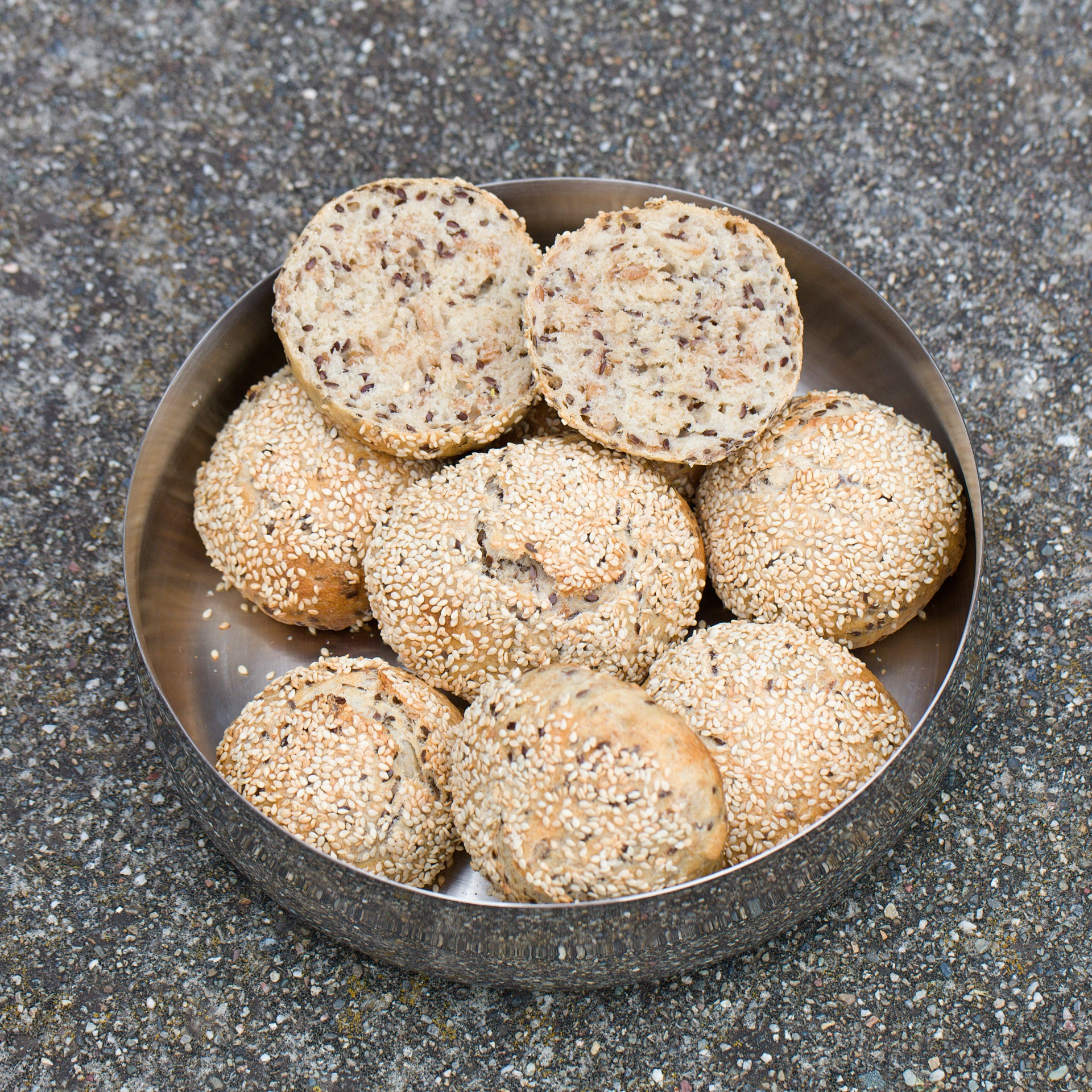
3-Grain Sourdough Rolls

Bread, Breakfast, BrunchTove Balle-Pedersen6 Comments
3-Grain Sourdough Rolls

3-Grain Sourdough Rolls

I had to try to make 3-grain sourdough rolls, and they turned out great. 

Makes 8

Ingredients:

  • 4 tablespoons mature sourdough (fed and fermented for about 8 hours*)
  • 300 ml water
  • 350 g all-purpose flour
  • 50 g whole wheat flour
  • 50 g flaxseeds 
  • 50 g rolled rye 
  • 40 ml cream or milk
  • 10 g salt

Sprinkles:

  • sesame seeds 

Directions:

Dissolve the sourdough in the water in  a large plastic bowl. I used a dough-rising bucket

Mix in the rest of the ingredients. You just have to mix the dough until all the flour is wet. Let the dough ferment in the bucket, lid on, on the kitchen counter overnight or 7-10 hours.

Gently pour the dough onto a well floured surface. Fold the somewhat wet dough into it self until the surface is firmed up, and the surface got a good tension. Divide the dough in 8 (about 100 g pr roll), roll the dough into a round ball, brush the dough with water and dip it in sesame seeds. Place the rolls on a baking sheet lined with parchment paper.

Let the rolls rise for 30-60 minutes, loosely covered with plastic wrap. I raised my rolls in my oven on the proof-setting.

Preheat the oven to 450℉ (230℃).

Place the rolls on the lower rack in the oven. Splash about ¼ cup of water in the bottom of the oven, and close the oven quickly. You need the steam to get the best oven spring and crust. Bake the rolls for about 22 minutes, until golden.

Let the rolls/rundstykker cool before serving.

Enjoy!

*To test the readiness of the sourdough, drop a spoonful into a bowl of room-temperature water. If it sinks, it is not ready and needs more time to ferment and ripen. If it floats, it is ready to use.

Pork Roullade with Prunes

Dinner, Meats, PorkTove Balle-PedersenComment
Pork Roullade with Prunes

Pork Roullade with Prunes

My mom loved this kind of pork roulade called rullesteg (rolled roast) in Danish. It might have been the prunes that made it special for her. And I have to agree with her, the prunes gives this roast a sweetness that pairs well with the pork and the saltiness.

Don't get me started about the gravy. Danes are a meat, potato and brown gravy kinda people. The sauce or gravy should be spooned over the potatoes and not just used as a small amount of dipping sauce. The sauce from a roast like this makes the most fantastic sauce. All the flavors from the roast is concentrated in the cooking liquid, making the sauce to die for.  I normally only make a sauce like this at christmas when we have roasted duck or/and Danish pork roast, but this roast calle for the traditional brown sauce. 

Ingredients:

  • 1½ kg (3 lbs) pork belly, no skin
  • 200 g pitted prunes
  • salt & pepper
  • butter and olive oil for the searing
  • 4-500 ml (2 cups) water

Directions:

Cut off any large chunks of fat, but don't make it too lean. Trim the ends so they are straight.   Lay the pork belly flat on a cutting board and sprinkle salt and pepper on both sides. Place the prunes on the pork belly along one of the sides. Roll the pork belly into a tight sausage keeping the prunes in the center. Use cooking twine to tie the meat up all the way.

Heat butter and oil in a pot, and sear the roast on all sides. Add the water, turn heat to low and let to simmer for about 90 minutes, turning a few times during the cooking process.  

Remove the roast from the pan, and let rest on a cutting board, before slicing.

Extra: Make a sauce from the cooking liquid, by adding cream (or whole milk) to the pan, and bring it to a boil. Thicken the sauce with a thick mixture of water and all-purpose flour. Add browning (kulør) to get the brown color. Season with salt, pepper and sugar.

Serve the roast sliced thin with boiled potatoes and some kind of vegetables.

Enjoy!

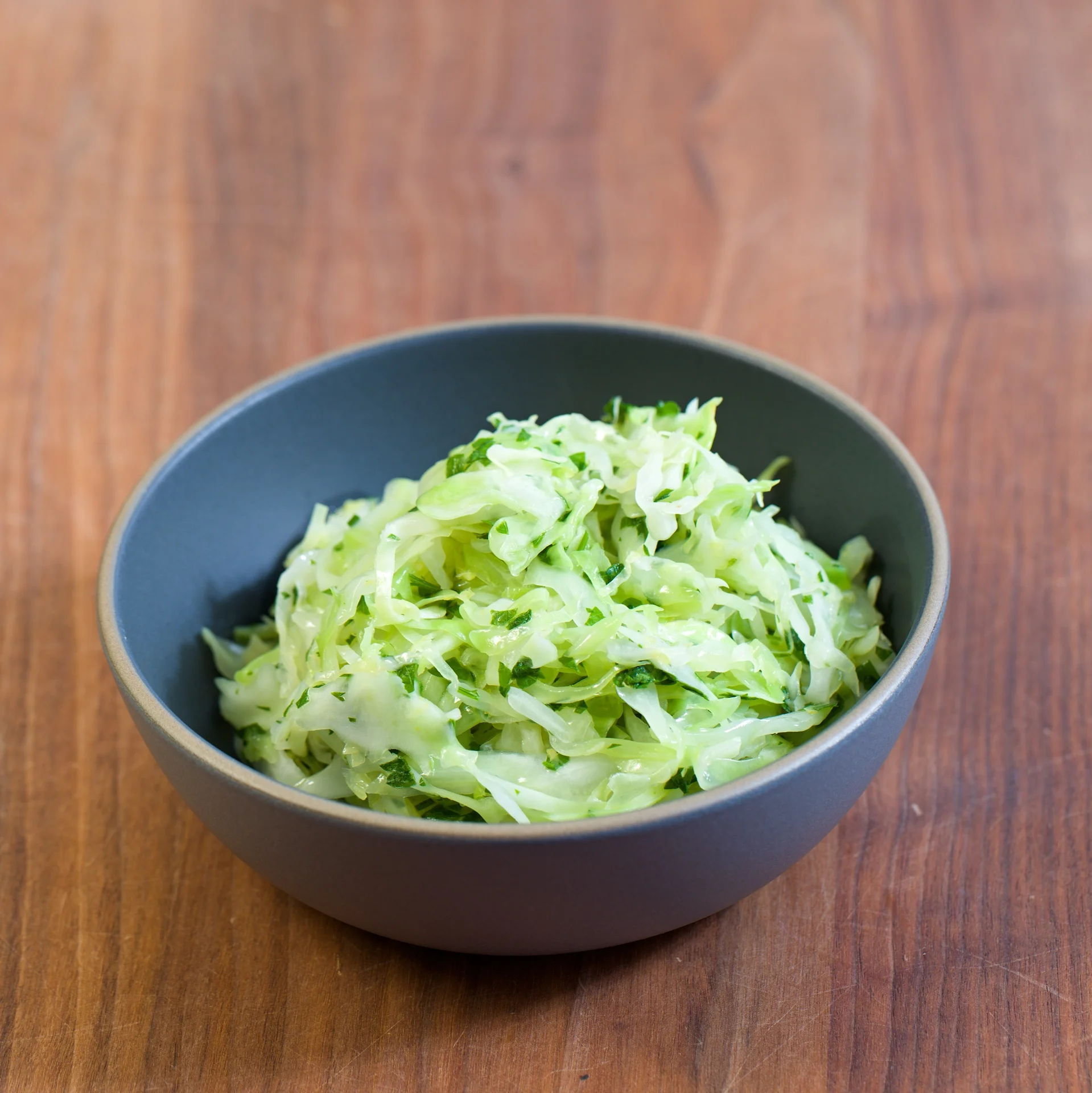
Warm Cabbage Salad

Dinner, Salad, Sides, VegetablesTove Balle-PedersenComment
Warm Cabbage Salad

Warm Cabbage Salad

I love cabbage. It's cheap, healthy and easy to make. You can use it raw or cook it. When you sauté it like in this recipe, you still get the crunchy texture and a mild flavor. You can pull the flavor profile in different directions, by adding chili, curry or keep it mild with lemon and parsley.

Serves 3-4

Ingredients:

  • 1 medium head of green cabbage, thinly sliced
  • 1 tablespoon butter
  • 1 lemon, the zest of
  • 1 handful Italian parsley, chopped
  • salt to taste
  • lemon juice or white balsamic vinegar to taste


Directions:

Melt the butter in a sauté pan, don't let it brown. Sauté the cabbage until it starts to get tender. You still want it to be crispy, but not raw. Turn off the heat, and mix in parsley and lemon zest. Season the salad with salt and lemon juice or vinegar.

Serve immediately.

Enjoy!


Skidne Æg - Eggs in Mustard Sauce

Holiday, LunchTove Balle-Pedersen4 Comments
Skidne Æg - Eggs in Mustard Sauce

Skidne Æg - Eggs in Mustard Sauce

Eggs in mustard sauce is a classic old Danish easter lunch dish eaten Saturday before easter. In Denmark easter is two sets of two religious holidays. Skærtorsdag (Maundy Thursday), Langfredag (Good Friday), Påskedag (Easter Sunday) and 2. Påskedag (Easter Monday). In between the sets of religious holidays, is Saturday. This Saturday called skiden lørdag (dirty Saturday . because it was used to clean up from all the entertaining Thursday and Friday, and make the house presentable for more entertaining during the easter days.  So the Danes wanted an easy dish to serve on this busy day, and the dish eggs in mustard sauce was born, and got the weird name dirty eggs or skidne æg.

In my family we didn't have egg hunts or easter egg roll. We got easter eggs, and we had the first of the 3 big family lunches of the year. I loved these lunches, because it was here we saw all our cousins and extended family. And we alway went for a walk in the forest close to my aunts house, and we saw the first real signs of spring, with the small flowers under the trees.   

Serves 2.

Ingredients:

  • 4 eggs

Sauce:

  • 2 tablespoons butter

  • 2 large tablespoons all-purpose flour

  • about 2 cups milk

  • 2-3 tablespoons mustard, I used haft a coarse mustard and half dijon

  • salt & pepper to taste

Topping: 

Direction:

Bring a small pot of water to a boil. Carefully add the eggs and boil until a little more than soft boiled. I cooked my large eggs for 7 minutes.  Cooking time varies depending on egg size.

Cress or peppergrass sprouts.

Cress or peppergrass sprouts.

Drain the water from the eggs, and pour cold water into the pot to stop the cooking. Peel the eggs and set aside.

While coking the eggs make the sauce. Melt the butter in a small pan, you don’t want the butter to brown. When the butter is melted add flour and a pinch of salt and whisk vigorously, making the flour absorbing all the butter. Add the milk a little of a time, while whisking, until you have the right consistency, like a béchamel sauce. Let the sauce cook for 1-2 minutes, this with remove the floury taste. Season the sauce with mustard, salt and pepper. You want to have a strong mustard taste, so use your favorite non-sweet mustard.

Add boiled eggs to a serving dish, and pour over the sauce and sprinkle with cress sprouts. Serve the eggs with a slice of toasted danish rye bread

Enjoy!