Sweet • Sour • Savory

Food blog on scandinavian style food done right.

Wienerschnitzel - Danish style Schnitzel

Dinner, Meats, PorkTove Balle-Pedersen3 Comments

Wienerschnitzel - Danish style Schnitzel.

Schnitzel is a classic Austrian or German dish. The German version is made with pork, and the Austrian is made with veal. But the Danish version can be made with both, but mostly I make it with veal.

The Danish wienerschnitzel is served with something called a boy, or dreng in Danish. The boy is the topping, the lemon, capers, horseradish and brined anchovies. I have no idea why it is called a boy, but I love the salty and tangy addition to a rather fatty schnitzel. Normally I serve a wienerschnitzel with boiled potatoes, some steamed peas and a mushroom sauce, or sautéed mushrooms.

If you for some reason don’t like the topping, I would serve the schnitzel with a warm tangy potato salad with lots of fresh herbs.

Serves 2.

Ingredients:

  • 2 veal scaloppines

  • 1 cup all-purpose flour

  • salt and pepper

  • 2 eggs, lightly beaten

  • 2 cups unseasoned bakery bread crumbs or panko

  • Olive oil or clarified butter for frying, do not skimp

Topping:

  • 1 lemon, cut in slices

  • 2-3 tablespoons capers

  • horseradish, grated, to taste

  • 2-4 brined anchovies

Directions:

Prepare 3 shallow bowls. Place the flour, eggs, and bread crumbs in 3 separate large, shallow bowls. Season the veal scaloppine with salt and pepper. Start dipping each scaloppine/schnitzel in flour, shaking off the excess. Then dip each completely in the eggs. Drain the scaloppine from the eggs and dredge them in the third bowl with bread crumbs, pressing the veal lightly into the crumbs to adhere. Place the breaded scaloppine/schnitzel on a plate or some parchment paper.

Heat the oil/clarified butter in a large skillet over medium-high. Cook the scaloppine/schnitzels for 4 minutes on each side, only turning them once. Add more oil or butter when turning, so the pan won’t run dry. You want the schnitzels to be golden brown and crisp. Transfer the schnitzel to some paper towels to drain excess fat. Place a schnitzel on each plate and top them with lemon, capers, horseradish and anchovies.

Serve the wienerschnitzel with boiled potatoes, peas and mushrooms and with a cream of mushroom sauce.

Enjoy!
Shakshuka a la the Danes

Breakfast, Brunch, Vegetables, VegetarianTove Balle-PedersenComment

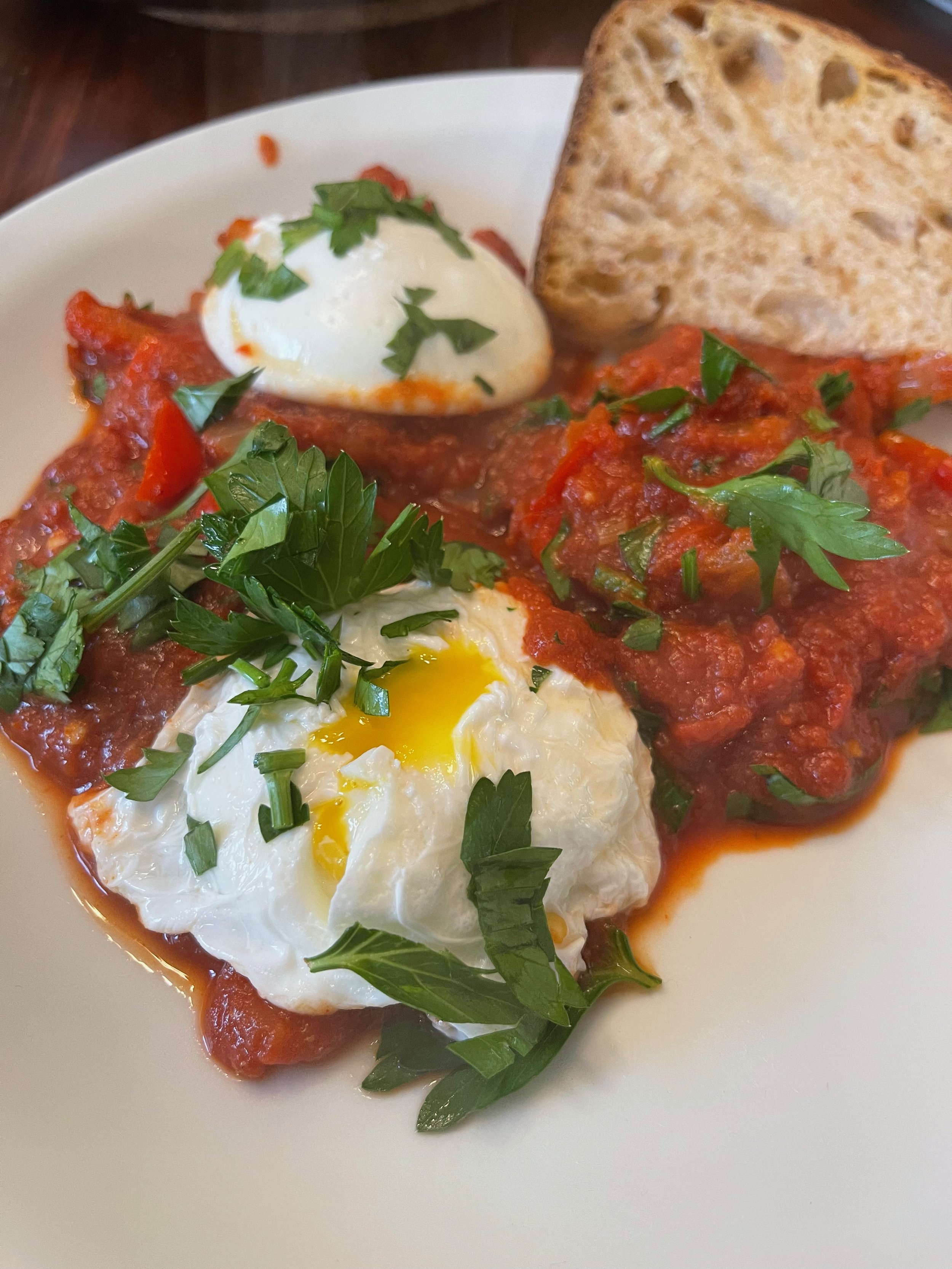
Shakshuka a la the Danes

Shakshuka is a spicy sauce of tomatoes and other vegetables with poached eggs originating from North Africa, Tunisia. I first had it at a humus place, and remember it as kinda bland. But I liked the idea of the dish, and my version of the dish is not even close to bland. After serving this to my husband, it went into his top of breakfast dishes. I poach the eggs separately, so I can make a large pot of the sauce, even adding whatever vegetables I have on hand, and freeze it in smaller portions. By doing this Shakshuka becomes a quick breakfast, just heating the sauce, and poaching the eggs.

Serves 2-3.

Ingredients:

  • 1 onion, diced

  • 1 red bell pepper, diced

  • 2 garlic clove, minced

  • 1 can diced tomatoes

  • 1½ teaspoon cumin

  • ¼ teaspoon cayenne pepper or red chili flakes

  • 1 teaspoon paprika (½ mild and ½ smoked)

  • salt, to taste

Topping

Directions:

In a deep frying pan, heat the oil and cook the onion and bell pepper for around 5 minutes, until the onion is translucent. Stir in the spices and garlic and cook for a couple more minutes. Add the tomatoes and season with salt and pepper to taste. Let the sauce simmer gently for 15 minutes, letting the sauce thicken a bit.

(For the traditional shakshuka make up 4 hollows in the sauce, and crack an egg in each one, cover the pan with a lid and cook for another 5-8 minutes until the desired doneness of the eggs.)

I make poached eggs and serve them on top, because I think it’s easier to control.

Now, with a large spoon, make four hollows at the points of the compass in the mixture.

Just before serving place the poached eggs on top, and sprinkle with chopped chili and parsley.

Serve the dish immediately with a slice of good bread, preferably toasted.

Enjoy!

Poached Eggs version 2

Breakfast, Brunch, techniqueTove Balle-PedersenComment

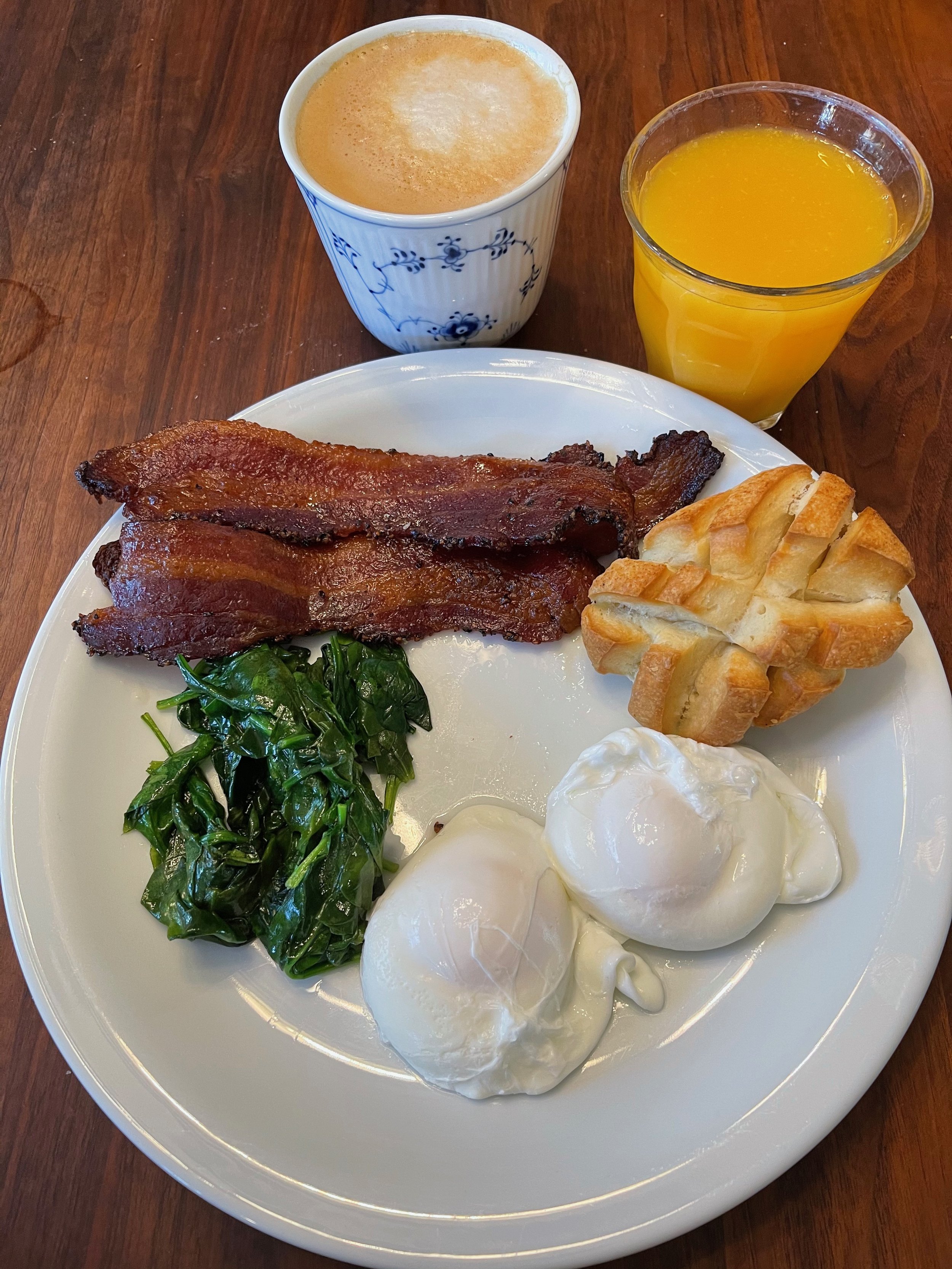
Poached Eggs.

I really love poached eggs, but it’s kinda a new love. Before we moved to California, it wasn't really a thing for me. Back then I preferred soft boiled eggs. But a poached egg is pretty much a naked soft boiled egg 😆, so maybe I didn’t change much 😳

I thought I had found a foolproof method, but it was hard to make more eggs at a time, when making a whirlpool in the pot. So with this newer (to me) method, I’m able to make 4 eggs at the same time. And I perfected this method to fit my family.

I use my thick bottomed sauté pan, it is wide and shallow, and works perfect.

Eggs in general: When you want poached eggs, you need to use fresh eggs. When you crack the egg you can tell that you have a fresh egg, when the yolk is firm and plump, and the white consist of two parts: a gelatinous mass around the yolk and a runnier liquid.  As the egg ages, the white becomes more runny.  So the runnier the white, -  the older the egg. 

If you don't want to crack the eggs to figure out the freshness, here's a quick guide:

Place your eggs in a cup or bowl of fresh water

  • If the egg sinks and lays flat on the bottom, it's very fresh.

  • If the egg sits on the bottom at an angle,it's a bit older.

  • If the egg stands on end but still sits on the bottom, use for baking.

  • If the egg floats, it is old and you don't want to use it.

Serves 2-4

Ingredients:

  • 4 eggs

  • 2 tablespoons vinegar

Equipment needed:

  • Shallow saucepan with cover

  • Slotted spoon

Directions:

Crack the eggs into a cup each.

Bring the water to a boil, add the vinegar.

Turn off the heat.

Gently place the eggs in the pan with some space between them. Put on the lid.

Set the timer for 4 minutes when you have placed the first egg in the water.

Remove the eggs from the water with a slotted spoon in the same order as you put them in.

Serve immediately. Alternatively, place the egg in an ice bath and refrigerate up to 8 hours. Reheat in warm water just before serving.

Enjoy!


Lemony Kale and White Bean Soup

Dinner, Poultry, Soup, vegan, VegetarianTove Balle-PedersenComment

Lemony Kale and White Bean Soup

My mom often made kale soup during the winter months, but her soup was made with very fine chopped kale, it was kinda grated. It felt like I was eating the fresh cutting from the lawn, and the cut of meat was very fatty. To be honest, it was far from a favorite of mine, but my mom and dad loved it.

So here many years later, after I have been using kale in green salads, I wanted to try a white bean and kale soup, hoping not to visit my childhood kale soup traumas. Maybe that was why it took me years to muster enough courage to give it a try. As it turned out, this soup was nothing like my moms kale soup, actually it has become one of my favorite winter soups. The different textures and the tanginess of this soup makes all the difference. It makes an appearance on the menu in my house several times a month. It’s easy to make, and you have a comforting, warm, and healthy meal on the table within 25-30 minutes.

Normally I use Lacinato kale also known as Dinosaur, or Tuscan kale, but any kale will do. Just make sure to give it a rough chop, so you have something to chew on. If you want to keep the soup vegan, use vegetable stock and omit the chicken.

Serves 4-6.

Ingredients:

  • 1 tablespoon olive oil

  • 1 large onion, chopped

  • 1 clove of garlic, crushed

  • ½ teaspoon rosemary

  • ½ teaspoon thyme

  • 2 lemon, the juice

  • 2 liter (8 cups) chicken stock (or vegetable stock)

  • 250 g raw chicken tenders, cut bite sized

  • 2 cans cannellini beans, drained (not rinsed)

  • 250 g fresh kale, roughly chopped

Directions:

Heat the olive oil in a heavy bottom pot over medium heat add the onion, and cook them until soft and translucent, you don’t want them to be brown. Add the garlic and cook for a little minute. Stir in the herbs, and add vegetable or chicken stock, lemon juice and chicken tenders. Cover, and bring the stock to a boil. Turn the heat down so it gets to a simmer. After about 15 minutes, season with salt and pepper.

Add the white beans and kale, and let it heat through befor serving. This will give the kale a bright green color, but keep it crispy. Serve the soup hot, with some good bread.

Enjoy!


Kransekage - Danish Almond Wedding Cake

Desserts, Cookies, Holiday, New Year's Eve, CakeTove Balle-PedersenComment

Kransekage - Danish Almond Wedding Cake.

For me this is not a wedding cake, but a New Years Eve cake. Most Danes celebrates New Year by drinking champagne and eating kransekage. This year I decided to make numbers instead of the traditional top.

You get the best cake by using a mazipan/almond paste with more than 63% almonds, otherwise the cake will flatten, and flow out during the baking, masking a cookie.

Kransekage should be crispy outside and a soft inside.

Happy New Year from Copenhagen Denmark.

Makes about 100 cm kransekage (6 rings and the top ball)

Ingredients:

Kransekage:

  • 75g almonds blanched or ¾ cup slivered almonds

  • 150 g (1 cup) sugar

  • 1½ (48 g) egg whites

  • 375 g marzipan, use Ren Rå marcipan or this Almond Paste

Icing:

  • confectionary sugar (powdered sugar)

  • egg white

  • water

Directions:

Put almonds and sugar into food processor with the steel blade in place and process until finely pulverized. Add the egg whites and process until smooth. Be careful not to heat the mass to more than 95 - 104°F, else the egg white will cook. 

Shred the marzipan and add it and the almond/egg white mixture to a stand mixer fitted with the paddle attachment. Beat it until it's completely smooth and free of lumps. Form the dough into a ball, and refrigerate for 2-3 hours.

Preheat oven to 375℉ (190℃).

Weigh out 400 g Doug and roll it into a 70 cm log. By during this, you will get the perfect size kransekage, whether. you make pieces, a number cake or a top.
Bake the kransekage for 12 minutes or on til golden brown.

With the palm of your hand gently press each log into a rounded triangle. You can wet you hands a little so the dough won’t stick to your hands.

Form the logs into circles on the parchment paper. Make sure to connect the ends really well.

Cutting the log up making rings.

For the numbers you need 12 cm + 4 cm for the number 2. and 22 cm for the number 0.

If you make a top, you start with 7 cm, and roll it into a ball. For the next ring add 2 cm, so you form a ring out og the 9 cm piece. For each remaing ring add another 2 cm, this will make a perfect top. With this amount of dough, you can make a top with 6 rings and a top ball. (7 cm, 9 cm, 11 cm, 13 cm, 15cm , 17 cm, 19 cm )

A trick to making Danish Kransekage, is to make the rings tall. When you cut the rings or pieces is should be in the shape of a triangle.

Here you see the shape of rings or pieces cut through.

Don’t use the kransekage pans, the rings will become rounded on the bottom, and harder to stack. Shape the kransekage with your hands.

Bake the kransekage on parchment paper, on a double baking sheet, this will prevent the bottom from burning.

Mix the powdered sugar with egg white and water.

When making the icing, it should be thick, not runny at all. Put the icing in a piping bag, cut a tiny tiny hole in the bag. I use half water and half egg whites for the icing.

When piping the icing shouldn't be runny. You almost place the thin line of icing on the kransekage. the piping take time, don't rush it.

If you make a top place the rings on top of each other, lifting the rings with your fingers like hooks inside the rings. Glue the rings together with small dots of icing.

Enjoy!